Chain Link Fence Lifespan in New England: What Springfield Winters Do to a Fence
If you own a fence in the Springfield area, you already know what a New England winter does to anything standing in the ground. Chain link fence lifespan is one of the questions we hear most from homeowners dealing with a leaning section, a sagging gate, or a neighbor asking pointed questions about where the old fence actually sits. The short version: chain link holds up longer in this climate than almost anything else you can put on a property line. The longer version is worth understanding before you repair, replace, or install anything, because the ground here moves, and it does not care what your fence cost.
This guide walks through how long chain link actually lasts in western Massachusetts, what shortens or extends that number, how it compares to wood and vinyl in our freeze-thaw cycles, and how to tell whether the fence you have now needs a repair or a replacement.
Why Fence Lifespan Is a Different Question in New England
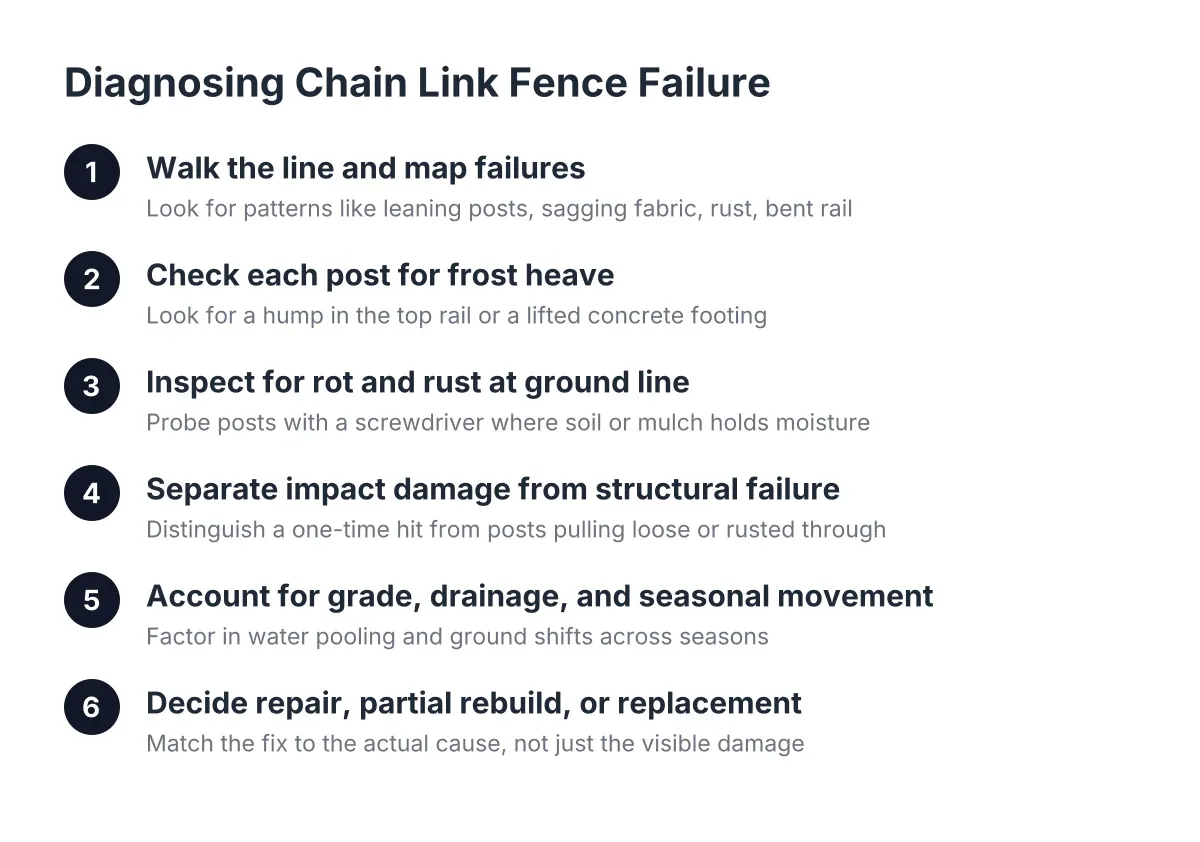
Most of what you read online about fence lifespan assumes mild weather and stable soil. Springfield has neither. Our winters push frost deep into the ground, and when that frost thaws in spring, the soil shifts. Any fence post set too shallow gets heaved upward a little each year until the whole line leans.
That matters because fence lifespan is mostly post lifespan. The fabric, pickets, or panels between posts rarely fail first. The posts do. A fence is only as old as the thing holding it up, and in our region, the thing holding it up fights the ground every winter.
Older New England housing stock adds another wrinkle. Lots in Springfield-area neighborhoods often have grade changes, mature tree roots, and property lines drawn long before anyone owned a string trimmer. A fence that was installed decades ago may be sitting in soil that has settled, eroded, or shifted since. When a homeowner calls about a leaning fence, the cause is usually underground, not in the part you can see.
So when you ask about chain link fence lifespan, you are really asking two questions. How long does the material last, and how long does the installation last? In this climate, the second question matters more.
How Long a Chain Link Fence Lasts in a Freeze-Thaw Climate
A well-installed chain link fence in the Springfield area commonly lasts several decades, often outliving the homeowner's stay in the house. Galvanized steel resists rust, the open mesh sheds snow load instead of catching it, and steel posts do not rot. The main threats are rust at scratch points, frost heave on shallow posts, and physical damage from vehicles, falling limbs, or snow plows.
Compare that to wood. According to Angi, wood fences last about 15 years on average, with some reaching 20 years depending on wood type and maintenance. Angi also notes that a wood fence over 10 years old needing frequent repairs is showing replacement signs. Wood posts rot at the ground line even when the panels above them have been repainted faithfully; the part you maintain is not the part that fails. Chain link skips that failure mode entirely because steel posts do not absorb water.
Here is the honest caveat. "Several decades" assumes the fence was built for this ground. A chain link fence with posts set above the frost line, or set in loose fill without proper concrete, can start leaning within a few winters. The material did not fail; the installation did. That distinction is why two chain link fences on the same street can look twenty years apart in condition while being the same age.
What Actually Shortens Chain Link Fence Lifespan
The lifespan of a chain link fence shrinks for a handful of specific, identifiable reasons, and almost all of them are preventable. In rough order of how often they show up on Springfield-area properties:
- Shallow post setting. Posts that do not reach below the frost line get pushed up by freeze-thaw cycles. This is the number one cause of leaning chain link in this region.
- Rust at damage points. Galvanizing protects steel until something scratches through it. A string trimmer hitting the same post every week, or a gate latch grinding against the fabric, opens a path for rust.
- Soil and drainage problems. Posts set where water pools sit in wet soil most of the year. Even galvanized steel corrodes faster in constantly saturated ground.
- Vines and vegetation. Ivy and bittersweet look harmless, but they hold moisture against the mesh and add weight and wind load the framework was never sized for.
- Impact damage. Plow banks, fallen limbs, and the occasional backing-up vehicle bend top rails and posts. A bent post stresses every connection down the line.
- Loose or failing fence ties. The small ties that hold the fabric to the framework work loose over time. Once the fabric sags away from the rail, wind works on it harder, and the sag accelerates.
None of these are exotic. A homeowner can spot most of them from the yard in ten minutes, which is worth doing each spring after the ground finishes thawing.
Chain Link Versus Wood and Vinyl When Winter Is the Opponent
Chain link outlasts wood in New England because steel posts do not rot and open mesh ignores snow and wind. Vinyl resists rot and fading, but it gets brittle in deep cold and can crack on impact. For raw durability against Springfield winters, chain link is the strongest of the three common residential fence types.
That does not make it the right fence for everyone. Each material trades something:
- Wood fence. Best privacy and a traditional look, but the posts rot, the boards warp and twist, and it demands maintenance. Staining both sides, not just the side facing you, meaningfully extends its life. Even so, expect to care for it like a deck.
- Vinyl fence. No rot, no painting, holds its color. However, vinyl is still PVC. It can crack when something hits it in freezing weather, and a damaged panel usually means replacing the panel, not patching it.
- Chain link fence. Longest service life for the money, minimal maintenance, and handles frost and wind better than either alternative. The trade-off is privacy. Standard mesh offers none, though privacy slats and darker color-coated options narrow that gap.
On color: chain link no longer means bare silver. Vinyl-coated chain link comes in black, green, brown, and occasionally blue, and the coating adds a second layer of rust protection over the galvanizing. A black chain link fence along a tree line tends to disappear visually, which surprises homeowners who picture a schoolyard fence.
There is a cost dimension here too, though it is about total cost, not the quote. The cheapest fence estimate often becomes the most expensive fence, because a fence built to a price instead of built to this climate gets rebuilt years sooner. Pricing differences between fence companies usually reflect real differences in post depth, material gauge, and expected longevity, not just markup. When you compare quotes, ask what post depth and concrete each number includes. Two bids for the same footage are not the same fence.
Why Chain Link Works for Property Line Fences
A property line fence has one job above all others: stay exactly where it was put, for a long time, without ambiguity. Chain link does that job well. It marks the line visibly without walling anyone off, it contains dogs and kids, and it will still be standing on that line twenty years from now, which matters if the line is ever questioned again.
Suppose a homeowner in a Springfield neighborhood has a new neighbor whose dog keeps crossing into the yard. The old fence, if there ever was one, is a few rotted posts and a memory. Nobody is sure where the line runs, the neighbor is friendly enough but firm, and nobody wants a lawyer involved. In that scenario, a chain link fence is often the practical answer: it is the most affordable way to put a durable, permanent marker on the boundary, it keeps the dog home, and it does not read as a hostile gesture the way a six-foot solid wall sometimes does.
One thing a fence company cannot do is tell you legally where your property line is. If the line is genuinely disputed, or if the fence location could end up in a disagreement later, a licensed surveyor is the professional to call before any posts go in. A good local installer will work from survey pins or marked lines and set the fence slightly inside your side of the line so there is no argument about encroachment. What an installer should never do is guess at the line because guessing is cheaper. Moving a fence after the fact costs far more than a survey.
Document the placement. Keep the survey, the fence estimate showing the layout, and photos of the pins before and after installation. If the boundary question ever comes up again, you have a paper trail instead of a shouting match over the fence.
Repair or Replace: Reading the Fence You Already Have
Many Springfield-area homeowners are not choosing a new fence. They are staring at an old one after a storm or a hard winter, trying to decide whether it needs a few hundred dollars of repair or a full fence replacement. For context, Angi puts the national average cost of fence repair at $618, with most homeowners paying between $304 and $948, while full fence installation averages $3,277 nationally. The gap between those numbers is why the repair-or-replace call is worth getting right.
Chain link is unusually repair-friendly, which works in your favor:
- A bent top rail can be cut out and replaced in sections without touching the rest of the fence.
- Damaged fabric can be unwoven at the break and spliced with new mesh; the repair is strong and nearly invisible on coated fence.
- One heaved or leaning post can be reset or replaced individually, as long as the posts around it are sound.
- A sagging gate usually needs hinge adjustment or a new gate frame, not a new fence.
Replacement starts to make more sense when the problems are systemic. If a third or more of the posts are leaning, if rust has gone past surface staining into flaking and holes, or if the fabric has stretched and sagged along most of the run, you are patching a fence that will keep generating repair calls. At that point, each repair is money spent on a structure that has reached the end of its chain link fence lifespan, and a replacement built to current standards resets the clock for decades.
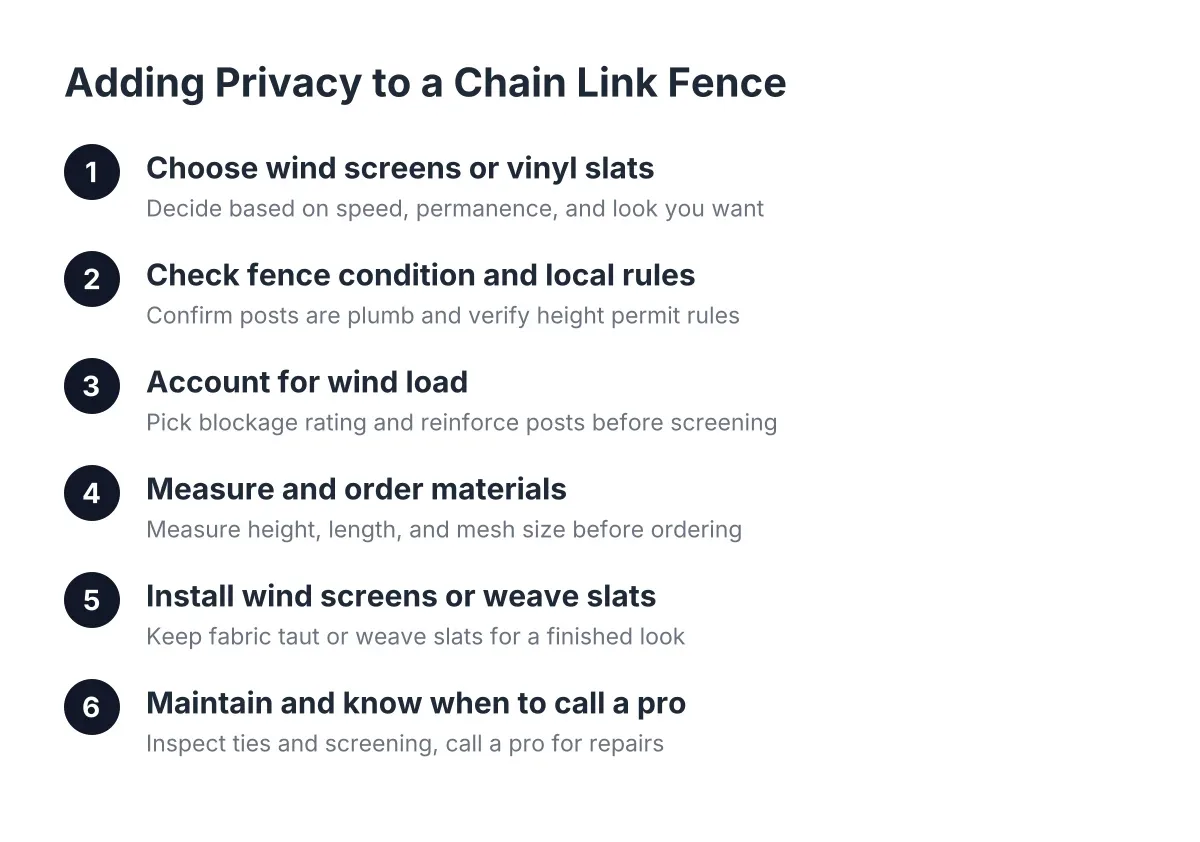
There is one situation worth knowing about if you are replacing a taller fence. Sound existing steel posts can sometimes be kept and reused, with new posts added between them. The resulting fence can stand up to wind better than a typical new fence of the same height, because the post spacing is tighter. Not every old fence qualifies; the existing posts have to be plumb, deep, and rust-free at the ground line. It is worth asking about before anything gets torn out.
Getting the Full Lifespan Out of a Chain Link Fence
Maximizing chain link fence lifespan in this climate comes down to three things: a correct installation, light annual attention, and fixing small damage before winter turns it into big damage. The installation part happens once. The rest takes less time per year than mowing the lawn takes per week.
First, the installation. Posts need to be set below the frost line in proper footings, spaced for the fence height and local wind exposure, and sized for the fabric they carry. Details most homeowners never see matter here; even the fence ties that attach the fabric to the framework come in different lengths matched to the pipe diameter, and the wrong hardware works loose years sooner. This is where paying for a careful local fence installation pays back, because every shortcut underground shows up above ground eventually.
After that, the maintenance list is short:
- Walk the fence line each spring after thaw. Look for posts that moved, ties that popped, and new sag in the fabric.
- Keep vines off the mesh and keep string trimmers off the posts. Both are slow-motion damage.
- Touch up scratches on galvanized or coated steel with cold galvanizing spray before rust starts.
- Fix impact damage the season it happens. A bent rail left through a winter of snow load becomes a bent rail plus stretched fabric plus stressed posts.
- Keep gates adjusted. A dragging gate stresses its posts, and gate posts are the hardest-working posts on the fence.
Do those five things and a quality chain link fence in the Springfield area becomes the last fence most homeowners ever think about. The material was built for exactly the conditions this region throws at it. The only question is whether the installation underneath it was too.
The ground here will test any fence you put in it, every winter, for as long as the fence stands. Chain link passes that test longer than its alternatives, which is why it remains the workhorse fence for property lines, pets, and budgets across western Massachusetts. Know what you have, fix small problems while they are small, and when it is time for new fence installation, judge the quotes by what goes below the frost line, not just the number at the bottom of the page.
If you need chain link fence installation, Western Mass Fence Co can help.
Prefer to talk it through? Call (413) 305-1309 — a quick call is usually the fastest way to get a straight answer for your situation.