Why Chain Link Fences Fail: Frost Heave, Post Rot, and Ground Movement
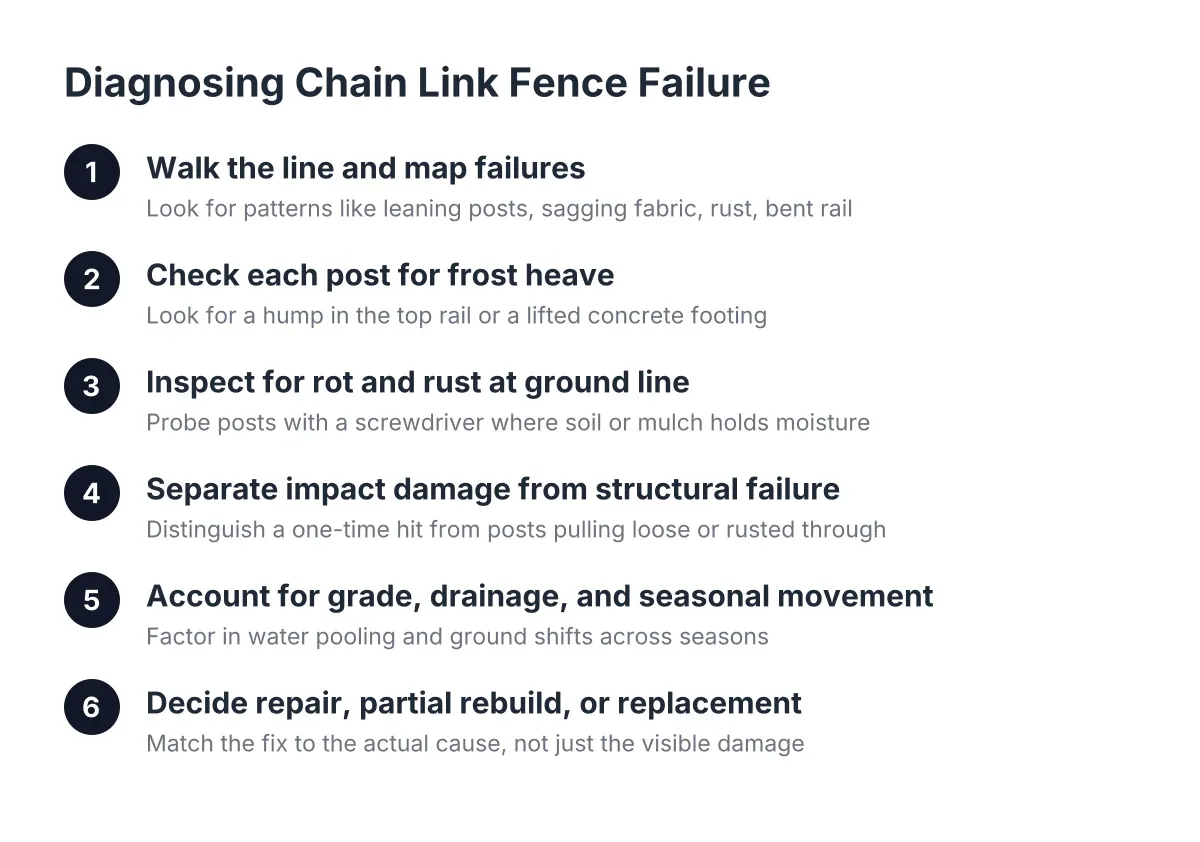
A storm knocks a section flat, a post leans after a hard winter, or the gate suddenly won't latch. In the Springfield area, chain link fence failures occur for a short list of predictable reasons, and most of them trace back to what is happening below the ground, not above it. Frost heave, failing concrete footings, and seasonal ground movement do more damage here than wind ever will. This guide walks through how to diagnose the failure step by step, so you can tell whether you need a repair, a partial rebuild, or a full fence replacement before you call anyone.
That matters whether you are a homeowner staring at a flattened section after a storm or a landlord who just got a tenant complaint about a sagging fence at a rental. Knowing the cause changes what you should pay for. Fixing the fabric on a fence with heaved posts is money spent twice.
Step 1: Walk the Line and Map Where the Fence Is Failing
Start with a slow walk along the entire fence, not just the obvious damage. Chain link fences fail in patterns, and the pattern tells you the cause. One crushed section under a fallen branch is impact damage. Three or four posts leaning the same direction along one run usually means the ground moved, not the fence.
Carry your phone and photograph everything as you go. If a storm or a vehicle caused the damage, those photos matter for any insurance conversation, and it is worth taking them before you touch anything.
Note these specifics on your walk:
- Posts that lean, wobble when pushed, or have risen above their original height
- Concrete footings that are cracked, tilted, or sticking up out of the ground
- Fabric that sags between posts even where posts look straight
- Rust at the ground line on posts, especially where soil or mulch piles against them
- Top rail sections that are bent, separated at the sleeves, or bowing downward
- Gates that drag, won't latch, or have shifted out of square with their posts
For a landlord with several Springfield-area properties, do this walk at every unit before requesting quotes. A fence company can price a multi-property repair list far more efficiently than a series of one-off emergency calls, and you avoid paying emergency pricing for problems that were months in the making.
Step 2: Check Each Post for Frost Heave
Frost heave is the number one reason chain link fences fail in New England. When the ground freezes, water in the soil expands and grabs the concrete footing, lifting the post. The spring thaw does not always set it back down in the same place. Over several winters, a post can rise an inch or more, tilt, and pull the fabric and top rail out of alignment with it.
Here is how to spot it. Look at the top rail from the end of a run. A heaved post shows as a hump in the line, with the rail rising and falling instead of running level or following the grade evenly. At ground level, check whether the concrete footing has lifted; you may see a gap or a ring of disturbed soil around it.
Frost heave points to a footing problem, and that is a depth problem. Footings that stop above the local frost line give the freezing ground something to grab. A heaved post almost never settles back on its own, so the fix is to reset or replace the post with a footing poured below frost depth. Patching the fabric around it just hides a failure that will return next winter.
Why shallow footings cause chain link fence failure
A post needs a generous amount of concrete around it on all sides to resist lateral force and frost grab. An undersized footing cracks under load, and once the concrete breaks, the post wobbles at the break point no matter how solid it looks from above. If you can rock a post by hand and hear or feel movement below the surface, assume the footing has failed even if the pipe itself is in good shape. This is a common finding on older Springfield-area fences that were set fast and shallow decades ago.
Step 3: Inspect for Rot and Rust at the Ground Line
The ground line is where fences die. On a chain link fence with steel posts, the failure mode is rust where soil, mulch, or wet leaves sit against the pipe and hold moisture. Galvanizing wears thinnest right there, and once rust gets through, the post loses strength exactly where the bending stress is highest.
Probe each post at the soil line with a screwdriver. Solid steel resists; a rusted-through post flakes or dents. Pay extra attention to low spots in the yard where water pools, and to posts near downspouts.
Some older fence lines mix materials, and wood is the weak partner. Wood posts rot at the ground line even when the rest of the fence has been maintained, and concrete backfill can make it worse by trapping moisture against the wood instead of letting it drain. A knot near ground level weakens a wood post right where it is stressed most. If a wood post is rotting at grade but its concrete footing is sound, one cost-effective fix is cutting the post above the rot and setting a new steel post into the existing footing, rather than digging the whole footing out.
Step 4: Separate Impact Damage from Structural Failure
Impact damage and structural failure call for different responses, and mixing them up is how people overpay. Suppose a storm drops a maple limb across twenty feet of fence at a Springfield two-family. The fabric is crushed and the top rail is bent, but the posts on either side stand plumb and tight. In that scenario, a repair makes sense: new fabric, new rail sections, same posts. The structure never failed; something hit it.
Now flip it. Say the same limb falls, and when the crew pulls the debris, two posts pull loose from cracked footings and a third shows rust-through at the soil line. The branch did not cause that chain link fence failure; it exposed a fence that was already failing. Repairing the crushed section while leaving compromised posts in the rest of the run means paying for the same stretch of fence twice.
Use this rough sorting rule:
- Bent fabric or rail, posts solid and plumb: repair.
- One or two posts heaved or rusted in an otherwise sound fence: targeted post replacement with proper footings.
- Multiple posts failing along a run, widespread ground-line rust, or footings cracking throughout: fence replacement is usually the better spend.
As a reference point, Angi reports the national average cost of fence repair at $618, with most homeowners paying between $304 and $948, while overall fence installation averages $3,277 nationally. Those are national figures, not Springfield quotes, but they show why the repair-or-replace call deserves an honest assessment rather than a guess under pressure.
Step 5: Account for Grade, Drainage, and Seasonal Movement
Ground movement is slower than a storm but just as destructive. Springfield-area lots often have grade changes, older fill, and drainage patterns that shift soil season after season. A fence set across a slope or through a wet low spot takes that movement in its posts.
Therefore, look beyond the fence itself. Water running along the fence line erodes support around footings. Soil that stays saturated freezes harder and heaves higher. If one section of your fence keeps failing while the rest holds, the ground under that section is usually the reason, and the fix may involve drainage or deeper footings, not just new parts.
This is where a professional assessment earns its cost. Grade, frost depth, and soil conditions are hard to judge from the surface, and an installer who works these neighborhoods will set posts for the ground that is actually there. A fence estimate that addresses footing depth and drainage is worth more than a cheaper one that only counts feet of fabric.
Step 6: Decide on Repair, Partial Rebuild, or Replacement
Pull your notes together and make the call based on structure, not appearance. Fabric and rails are the cheap, replaceable parts of a chain link fence; posts and footings are the structure. A fence with sound posts and ugly fabric is a repair. A fence with pretty fabric and failing posts is a replacement waiting for a date.
In addition, weigh age and the failure count. If you are replacing your second or third post in as many years, the rest of the run was likely set the same way at the same time, and failures will keep coming one emergency at a time. For a landlord budgeting across several units, scheduling one planned fence replacement often beats funding a string of urgent repairs, both in cost per foot and in tenant complaints.
One honest limitation: no checklist replaces eyes on the specific fence. Soil, footing depth, and hidden rust vary post by post, and a walkthrough with a local fence company will catch what a surface inspection cannot. If kids or pets depend on the fence holding, get that assessment before the next storm, not after it.
The takeaway is simple. Chain link fences fail from the ground up, so diagnose from the ground up. Find the frost heave, the rot, and the rust first, and the repair-or-replace decision mostly makes itself.
If you need chain link fence installation, Western Mass Fence Co can help.
Prefer to talk it through? Call (413) 305-1309 — a quick call is usually the fastest way to get a straight answer for your situation.