How Much Does Fence Installation Cost?
How much does fence installation cost? The honest answer depends on three things more than anything else: the length of fence you need, the material you choose, and what your property throws at the installer, like slopes, rocky soil, or old fence that has to come out first. Anyone quoting you a fixed number before seeing those three things is guessing. By the end of this guide, you will know exactly what drives a fence estimate up or down in the Springfield area, and how to get a real number for your own yard instead of a made-up one.
What Drives the Cost of Fence Installation
Fence pricing is mostly math you can follow: linear feet of fence, times the cost per foot for the material and labor, plus anything about your property that slows the crew down. Here are the factors that matter.
Fence Length and Layout
Every fence quote starts with linear footage. More feet means more posts, more panels, and more labor, so a full backyard perimeter costs more than a short run between two houses. But layout matters too. A straight run along a flat property line installs fast. A fence that turns corners, steps around a shed, or follows a jagged lot line takes longer per foot. Walk your property line and count the corners. Each one adds a post and some time.
Material Choice
Chain link, wood, vinyl, and ornamental aluminum sit at different points on the price scale, and the gap between them is real. Chain link is usually the budget option. Wood sits in the middle, with the price shifting based on the style, since a simple picket fence costs less per foot than a six-foot solid privacy fence. Vinyl and ornamental aluminum cost more upfront but ask less of you in maintenance over the years. The right question is not just which material is cheapest today, but which total cost makes sense over the life of the fence. Our pages on wood fence installation and ornamental aluminum fence installation break down what each material gets you.
Fence Height and Style
A taller fence needs longer posts set deeper in the ground, more material per panel, and more labor to install. A four-foot chain link fence around a garden costs less per foot than a six-foot privacy fence around the same yard. Style choices within a material matter too. Solid privacy panels use more lumber than spaced pickets, and decorative toppers, lattice, and custom gates all add to the fence estimate. Know what the fence needs to do, like containing a dog, blocking a neighbor's view, or marking a property line. The job defines the height, and the height moves the price.
Site Conditions and Ground
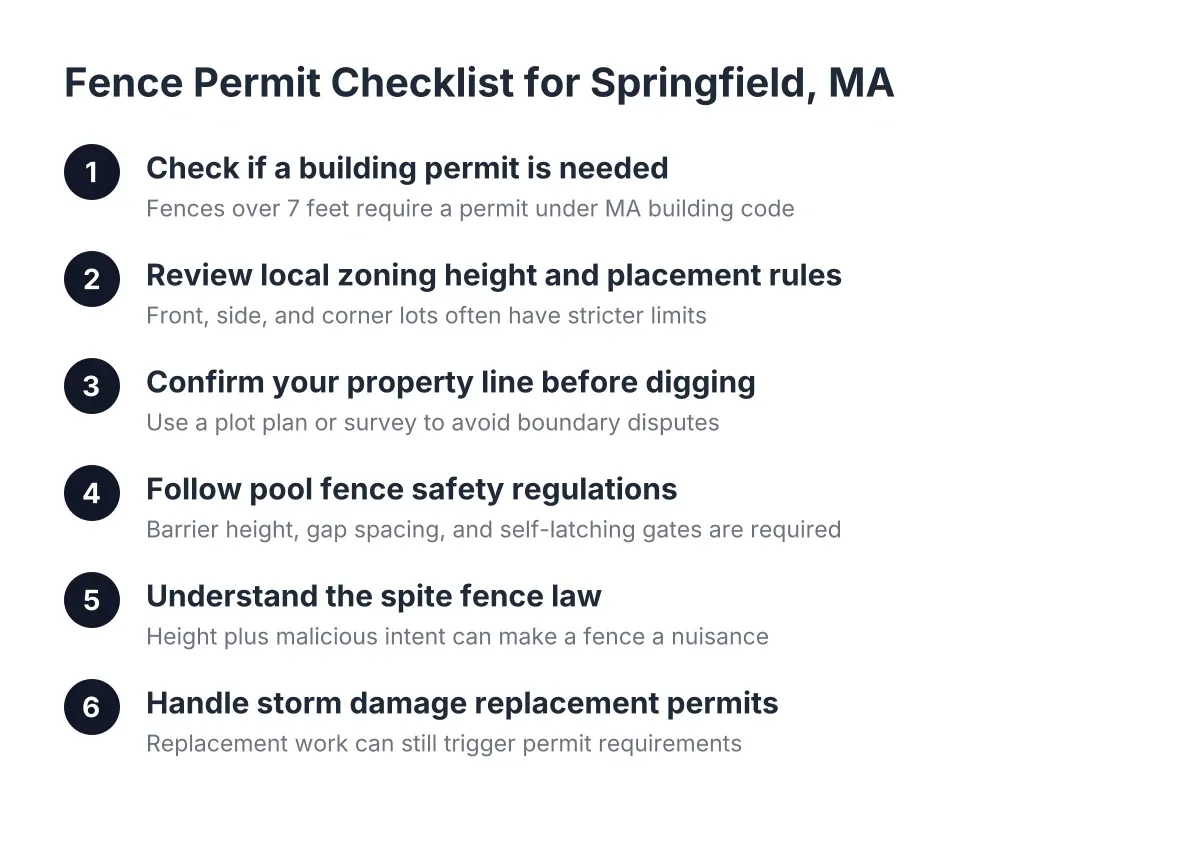
This is the factor that surprises people, and in western Massachusetts it matters more than in a lot of places. Older Springfield-area neighborhoods come with grade changes, tight property lines, mature tree roots, and soil that ranges from sandy to packed with rock. Posts here also have to be set below the frost line, because seasonal frost and ground movement will heave a shallow post out of plumb within a few winters. A flat, open, diggable yard keeps labor costs down. A sloped lot, rocky digging, or limited access for equipment pushes them up. Look at your yard honestly: if the ground rises or falls noticeably along the fence line, expect the installer to account for it.
Old Fence Removal
If you are replacing an existing fence, someone has to tear out the old one, pull the posts, and haul it away. Old posts set in concrete take real effort to remove, and that labor shows up on the quote. Some homeowners handle removal themselves to trim the cost, which is a fair move if you have the time and a way to dispose of the material. If your project is a tear-out and rebuild, our fence replacement page covers what that process looks like.
Gates and Extras
Gates are small in footage but big in labor. They need sturdier posts, hinges, latches, and careful alignment so they still swing cleanly after a few New England freeze-thaw cycles. A single walk gate adds a modest amount; a wide double drive gate adds more. Count the gates you actually need before you get quotes, because every one you add moves the number.
Cost Factor Table
| Factor | Pushes the price down when… | Pushes it up when… |
|---|---|---|
| Fence length and layout | The run is short and straight with few corners | The perimeter is long, jagged, or full of turns |
| Material | You choose chain link or a simple wood style | You choose vinyl, ornamental aluminum, or premium wood |
| Height and style | The fence is shorter with an open design | You need tall, solid privacy panels or custom details |
| Site conditions | The yard is flat, open, and easy to dig | The lot slopes, the soil is rocky, or access is tight |
| Old fence removal | There is no existing fence, or you remove it yourself | Old posts are set in concrete and need to be hauled out |
| Gates | You need one standard walk gate or none | You add multiple gates or a wide drive gate |
How to Get an Accurate Fence Installation Estimate
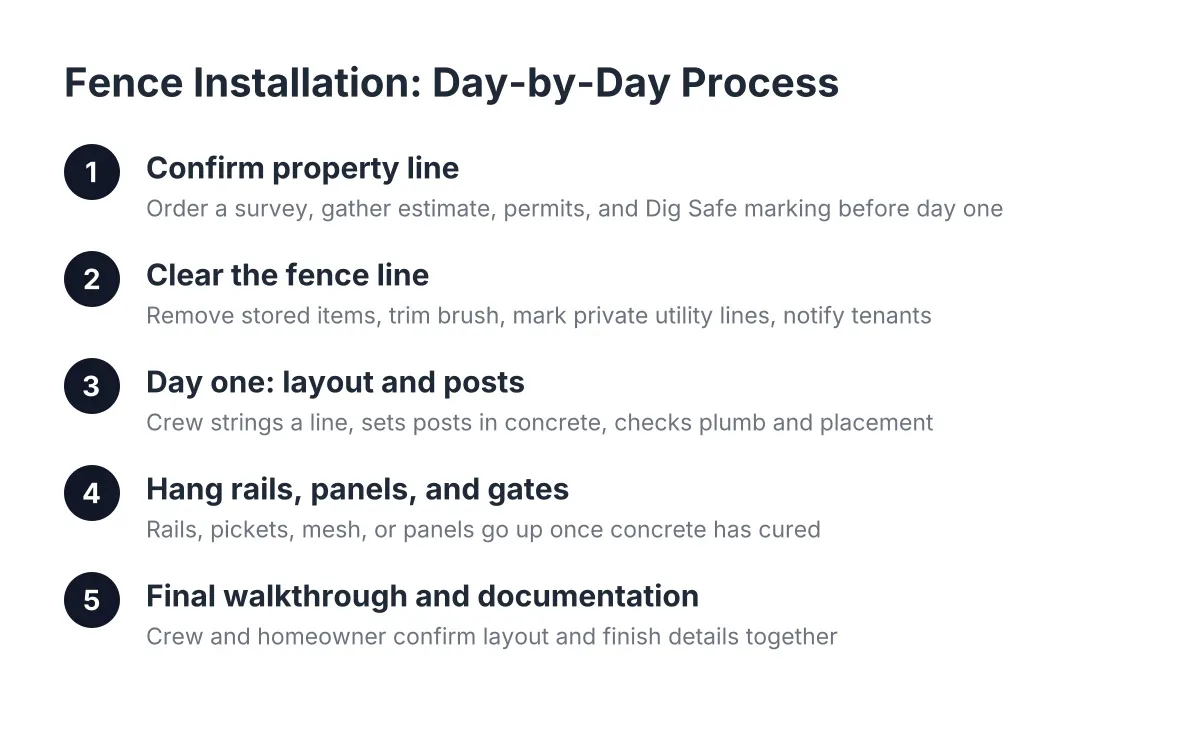
The fastest way to a real number is an on-site look at your property. Before that happens, you can get ahead by having a few things ready:
- Your rough footage. Pace off the fence line or measure it with a tape or a phone app. Even a ballpark helps.
- Your property line. Know where it is, or at least where you believe it is. A plot plan or survey helps, especially in older Springfield neighborhoods where fence lines and deed lines do not always agree.
- The job the fence needs to do. Privacy, pet containment, security, or curb appeal. This settles height and material fast.
- Photos of the fence line. Slopes, trees, old fencing, and anything else the installer should know about.
A good fence estimate puts everything in writing: the material and style, the height, the total footage, the number of posts and gates, how deep the posts are set, whether old fence removal is included, and who handles permits or utility marking. If a quote is just one number on a page, ask for the breakdown.
Estimates also differ between providers for real reasons, not just markup. One fence company may price a deeper post setting, heavier-gauge chain link, or thicker vinyl than another, and the cheaper quote is sometimes cheaper because the spec is lighter. Compare quotes line by line, not just bottom line to bottom line. If you want to talk through options for your property, our fence installation page is the place to start.
Ways to Keep the Cost Down
You do not need gimmicks to lower a fence price. You need smart scope decisions.
- Match the material to the job, not the whole yard to one material. Plenty of homeowners run privacy fence along the back line where it matters and chain link along the sides where it does not. Mixing materials where it makes sense can cut the total meaningfully.
- Fence what you need, not the full perimeter. A dog run or a backyard enclosure costs less than wrapping the entire lot. You can always extend later.
- Handle old fence removal yourself. If you have the tools and a disposal plan, tearing out the old fence is honest sweat equity that comes straight off the labor.
- Get two or three written quotes. Not to grind anyone down, but to see where specs differ. The comparison itself teaches you what you are paying for.
- Maintain what you install. For wood fences especially, staining or sealing on schedule keeps posts and pickets from rotting early. The cheapest fence is the one you do not replace ten years ahead of schedule.
Cost Questions People Ask
What do local fence companies charge per foot?
Searching for fence company prices in the Springfield area turns up a wide spread, and that spread is honest. Cost per foot moves with material, height, and site conditions, so a four-foot chain link fence on flat ground and a six-foot vinyl privacy fence on a slope sit at opposite ends of the range. The only per-foot number that matters is the one on a written quote for your specific property. Get two or three and compare the specs behind each number.
Is it cheaper to repair a fence or replace it?
It depends on how much of the fence is failing. A few leaning posts or broken pickets usually make fence repair the cheaper call. But if the posts are rotting at ground level or frost heave has pushed the whole line out of plumb, repairs become a slow, expensive way to buy a new fence one section at a time. An honest installer will tell you which side of that line your fence is on.
Does a commercial fence cost more than a residential fence?
Often, yes, but for practical reasons rather than markup. Commercial projects tend to involve longer runs, taller fencing, heavier-gauge materials, and security requirements that residential jobs do not have. The cost factors are the same ones in this guide, just scaled up. See our commercial fence installation page for how those projects work.
Why did my two fence quotes come back so different?
Usually because the quotes describe two different fences. Check the post depth, the material gauge or lumber grade, whether removal and haul-away are included, and how gates are specced. In this region, post depth matters: a post set below the frost line costs more to install than a shallow one, and it is the difference between a fence that stays straight and one that heaves. The lower quote is only the better deal if the spec matches.
The Bottom Line
The cost of fence installation comes down to footage, material, and what your property demands, and no honest number exists until someone measures your fence line. Gather two or three written quotes, compare the specs rather than just the totals, and ask every installer how they handle frost-depth post setting. If you are in the Springfield area, we are glad to walk your property line and give you a straight number.
Prefer to talk it through? Call (413) 305-1309 — a quick call is usually the fastest way to get a straight answer for your situation.