Commercial Fence Installation Security: Liability and ROI for Property Owners
A fence around a commercial or rental property does more work than most owners give it credit for. When people think about commercial fence installation, security is usually the first reason on the list, but it is rarely the only one. The fence that keeps people out of a parking lot after hours is the same fence that limits your liability when a kid wanders toward a dumpster area, and the same fence that signals to a prospective tenant that the property is cared for. Understanding commercial fence security liability—how these elements connect—is the difference between buying a fence once and buying the same fence twice. For Springfield-area businesses and small landlords, this relationship shapes both immediate security and long-term protection.
This guide walks through what a commercial fence actually protects, how to think about the cost, and what to look for when you hire a local fence company to do the work. It is written for the property owner who may own one storefront or six rental buildings, and who needs a straight answer rather than a sales pitch.
Why a Damaged or Missing Fence Is a Bigger Problem Than It Looks
Here is the usual starting point. A windstorm comes through Hampden County, a tree limb drops, and a section of chain link fence is flat in the grass behind your duplex. Or a plow pushes snow into a fence line and crushes three sections. Or a car backs through the corner of a wood fence at a small commercial lot. The fence looked fine Friday. Monday morning, it is a problem.
The instinct is to treat it as cosmetic damage you will get to eventually. For a commercial or rental property, that instinct is wrong, and for three reasons.
First, an open fence line is an open invitation. A gap in a fence around a storage yard, a parking area, or a multi-unit backyard removes the barrier that kept trespassers, dumping, and after-hours foot traffic off your property. Security problems rarely announce themselves in advance; they show up through the gap.
Second, liability exposure grows the longer the gap stays open. If a tenant's child or dog gets through a downed fence section, or someone gets hurt on equipment or debris your fence used to screen off, the question in any dispute will be how long the fence was down and whether the owner knew. A documented, prompt repair or replacement is a much better position to be in than a fence that sat broken for a season.
Third, tenants notice. A landlord with 2 to 15 units in the Springfield area knows that a broken fence is the kind of thing that shows up in tenant complaints, turnover conversations, and sometimes code enforcement letters. A standing fence is cheap insurance against all three.
What Commercial Fence Installation Security and Liability Actually Covers
Security fencing for a business or rental property means a fence system designed to control access, define the property line, and hold up to the conditions on that specific site. That includes the fence material, the gates, the post setting, and the layout around grade changes and existing structures. It is a system, not a row of panels.
In practice, commercial fence security and liability considerations cover more ground than most owners expect:
- Perimeter fencing around parking lots, storage areas, and building footprints, most often chain link for cost and durability.
- Gates and access points, which take more abuse than any other part of the fence and fail first when they are built cheap.
- Screening and privacy sections, often wood fence or vinyl fence, around dumpsters, mechanical equipment, or shared tenant yards.
- Ornamental aluminum fence runs where a business wants a secure street-facing line that does not look like a storage yard.
- Dividing fences between units at multi-family properties, where the goal is tenant privacy and clear boundaries as much as security.
A good installer will also handle the parts of the job the panels depend on: locating the property line, planning around slopes and old retaining walls, and setting posts deep enough with enough concrete to survive New England frost. A fence post needs a generous amount of concrete around it on all sides to resist movement over time. In this region, that detail decides whether the fence stands straight in five years or leans by the second spring.
Where Commercial Fence Security and Liability Protections Pay Off for Landlords
For a small landlord, the security case is less about intruders and more about control. A fenced backyard lets you advertise a unit as pet-friendly, which widens your tenant pool. A fenced parking area keeps non-tenants from using your lot. Additionally, a solid dividing fence between units cuts down on tenant disputes about shared space, which cuts down on calls to you.
Suppose a landlord owns a three-family in Springfield with a shared backyard and a chain link fence that a fallen maple limb took out last fall. Tenants have complained, one has a dog, and the open line borders an alley. In that scenario, replacing the damaged run and adding a gate turns a liability and a complaint generator back into a feature the next listing can mention. The fence is not decoration there; it is part of what the unit rents for.
Repair or Replace: The Question Every Storm-Damaged Owner Asks First
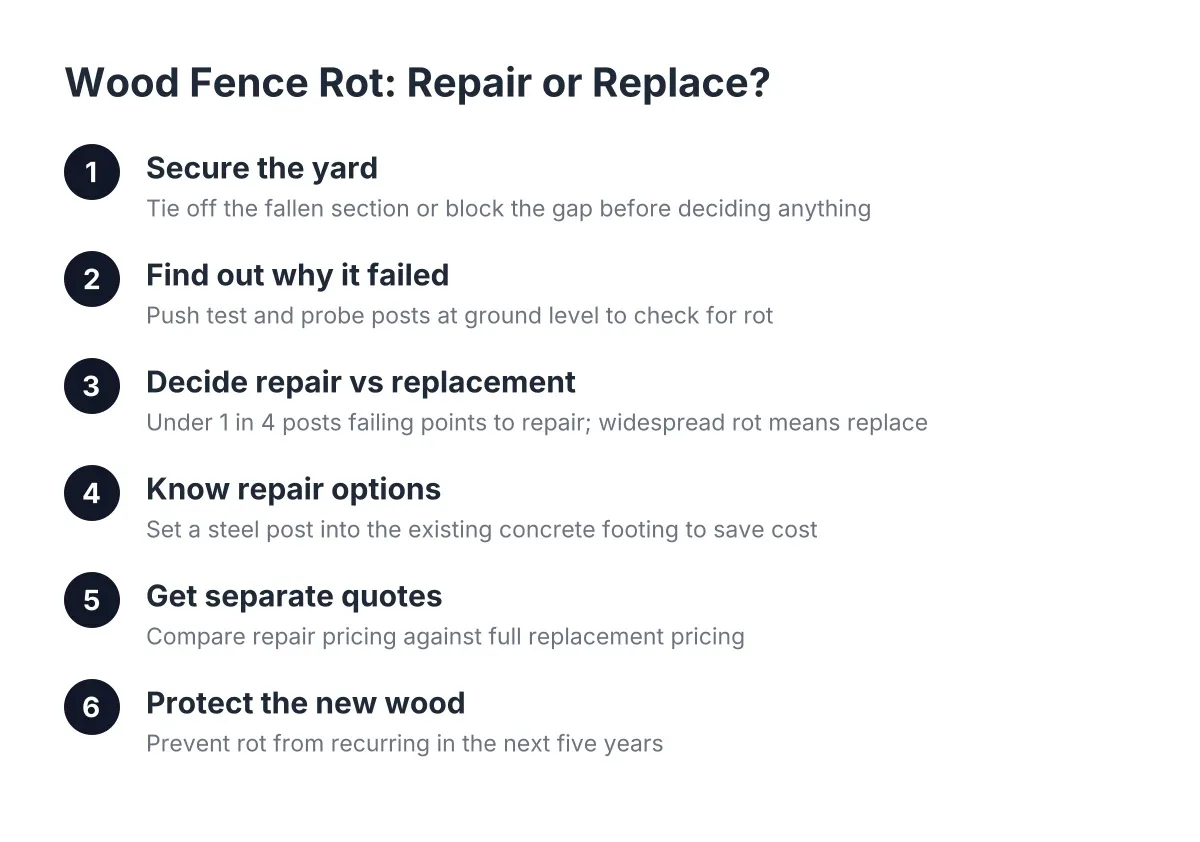
Whether a storm-damaged fence needs repair or full replacement depends on the posts, not the panels. If the posts are plumb, solid in the ground, and undamaged, a crew can usually replace the broken sections and the fence carries on. If the posts snapped, heaved, or rotted below grade, patching panels onto failing posts wastes money, because the structure underneath is already gone.
Here is a practical way to sort it out before anyone shows up:
- Count the damaged sections. One or two flattened sections of chain link or a few broken wood panels usually point toward repair.
- Check the posts along the whole line, not just the damaged spot. Push on them. Movement at the base means the ground connection has failed, and that failure will spread.
- Look at the age and condition of the undamaged fence. If the rest of the wood fence is gray, soft at the bottom of the pickets, and leaning, a repair buys you a year or two, not a decade.
- Factor in what the fence is doing for the property. A fence securing a rental yard or a commercial lot justifies replacement sooner than a purely decorative run, because the cost of it failing again is higher.
For reference, fence repair runs far less than installation. According to Angi, the national average cost of fence repair is $618, with most homeowners paying between $304 and $948, while full fence installation averages $3,277 nationally. Those are national figures, not Springfield quotes, but the gap between them explains why an honest repair-or-replace assessment matters. An owner should be suspicious of any contractor who recommends full replacement without walking the fence line and checking posts first.
This is also where a professional assessment earns its keep. Post condition below grade, frost damage, and property line questions are hard to judge from the surface, and getting them wrong means paying twice.
Security, Liability, and ROI in Commercial Fence Installation
The return on a commercial fence shows up in three ledgers: the value it adds, the losses it prevents, and the maintenance it avoids. According to Angi, installing a fence yields an average return on investment of around 50 percent of the project cost. For a residential sale, that is the headline number. For a business or rental property, it understates the case, because resale value is only one of the three ledgers.
Consider the prevented losses. A secured lot means less dumping, less vandalism, and fewer after-hours problems that turn into cleanup bills or insurance claims. A screened dumpster area means fewer complaints from neighbors and fewer notices from the city. None of that shows up on an appraisal, but all of it shows up in your operating costs.
Then there is the liability ledger. A fence that clearly marks the property line and controls access strengthens your position in almost any dispute involving trespass or injury on the property. For a landlord, a sound fence around a tenant yard is part of providing a safe premises. The cost of commercial fence installation is small next to the cost of one incident the fence would have prevented.
Material Choice Changes the Math
Different materials carry different ROI profiles, and the right answer depends on the job the fence is doing.
- Chain link fence is the workhorse for commercial fence installation and security applications. Lowest cost per foot among the common options, long service life, and easy to repair in sections when a plow or a limb takes out a run.
- Vinyl fence costs more upfront but needs almost no maintenance, which matters to a landlord who does not want to paint or stain fences across six properties every few years. The posts act as the foundation of a vinyl system, so post setting quality decides how long it lasts.
- Wood fence gives the best look per dollar for street-facing sections and tenant privacy, but it demands maintenance, and in this climate the bottoms of posts and pickets fail first.
- Ornamental aluminum fence suits a business that needs a secure perimeter with a professional appearance, at a higher cost per foot than chain link.
Pricing between contractors reflects more than material and labor. Construction practices, building style, and expected longevity all drive the number on the fence estimate. The cheapest bid often comes from the thinnest posts, the shallowest holes, and the least concrete, and that fence gets rebuilt years before a well-set one does. Paying less upfront and rebuilding sooner costs more over the life of the property than paying a fair price once.
Local Factors That Shape Springfield-Area Commercial Fencing
Western Massachusetts adds a few conditions to every fence project that an out-of-area playbook misses. Frost is the big one. Ground movement from seasonal freeze and thaw works on fence posts every winter, and a post that was set shallow or starved of concrete will heave and lean. Any fence meant to provide security has to be built for that cycle, because a leaning fence with gaps at the bottom is not securing anything.
Older housing stock is the second factor. Many Springfield-area multi-family properties sit on lots with unclear or irregular property lines, grade changes, old retaining walls, and existing fences from neighboring parcels. Fence layout on these lots takes planning. In tight spots, such as butting a new run against an existing neighbor's fence, an installer may reinforce a post with a metal pipe and sleeve the vinyl post over it to keep the line solid where a standard set will not work.
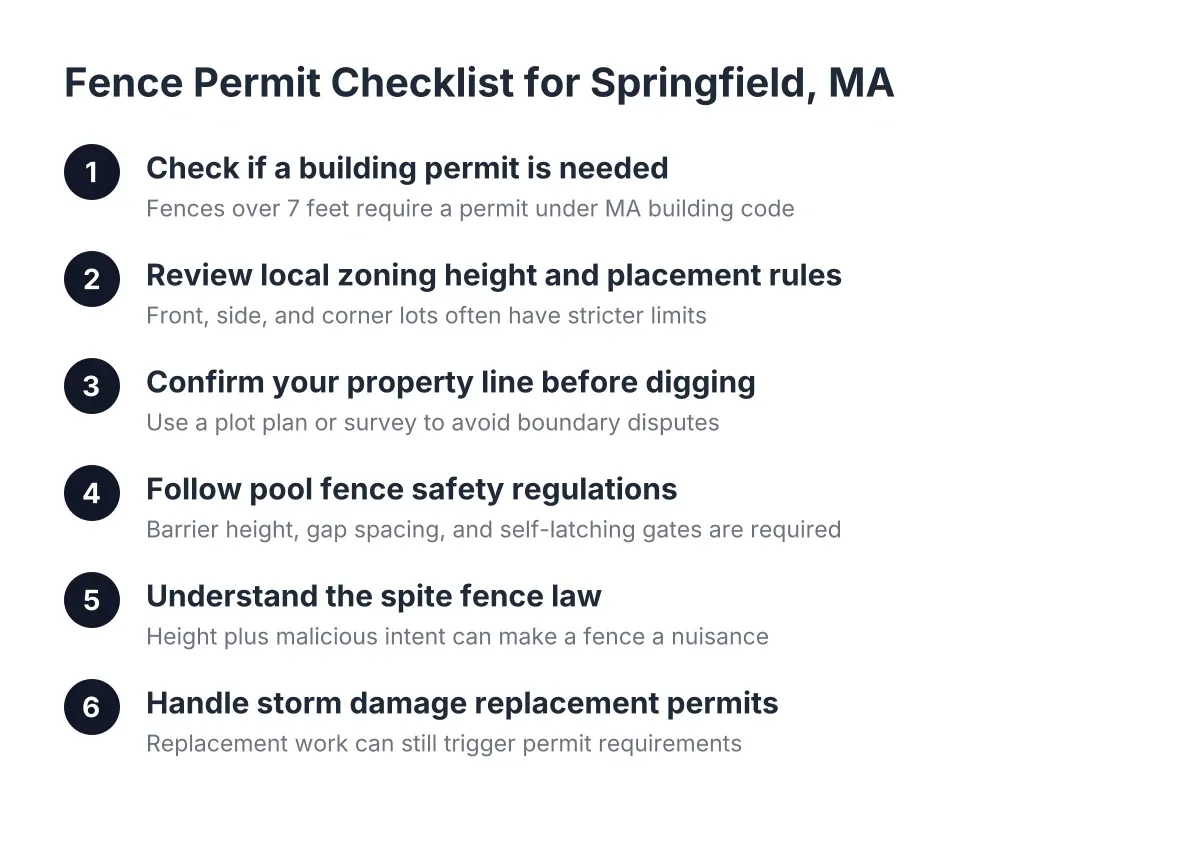
Permits are the third. Under the Massachusetts State Building Code, a fence over 7 feet tall requires a building permit, while fences 7 feet or less generally do not, according to the Town of Duxbury, MA. Local zoning rules on fence height and placement vary by municipality, so confirm requirements with your city or town before the project starts; a local fence company that works these streets will know what each municipality expects.
Season matters too. Crews can install fence most of the year here, but frozen ground slows post setting, so storm damage in January sometimes gets a temporary fix and a scheduled rebuild. Planning replacement work for a rental portfolio in the shoulder seasons usually means better scheduling.
How to Choose a Fence Contractor for Commercial or Rental Work
Choosing a fence contractor for commercial or rental property comes down to three things: whether they assess before they quote, whether the quote is specific, and whether they can come back for the next property. The market is crowded; the U.S. has more than 50,000 fence contractors, according to Grand View Research. Most of them can set a post. Fewer of them will tell you a repair is enough when you were braced to pay for a replacement.
Ask these questions before you commit:
- Will you walk the fence line and check the posts before quoting? A quote given over the phone without seeing the posts is a guess, and on a storm-damaged fence it is usually a guess in the contractor's favor.
- What exactly does the quote include? Post depth, concrete, gate hardware, haul-away of the old fence, and how property line questions get handled. A fair fence estimate itemizes these; a vague one hides them.
- Do you handle both repair and replacement, across materials? A contractor who only installs new vinyl fence will see every problem as a vinyl replacement. One who works in wood, chain link, and vinyl can match the fix to the problem and the budget.
For a landlord with multiple Springfield-area properties, add a fourth: can this contractor quote quickly and return for future units? Portfolio owners get the most value from a vendor relationship, not a one-off transaction. The same crew that replaced the chain link at one property can price the dividing fence at the next one without starting from zero. People searching for fencing installation near me or wood fence installation near me are often really searching for that relationship: someone local who picks up the phone the second time too.
One honest trade-off to keep in mind: the fastest available contractor is not always the right one. After a regional storm, every installer's schedule fills, and the outfit that can start tomorrow may be cutting the corners that made your last fence fail. A temporary fix to secure the gap, followed by a properly scheduled rebuild, usually beats a rushed permanent job.
Getting the Fence Line Secure Again
Whether you are a homeowner staring at a flattened section after a windstorm or a landlord fielding tenant complaints about a broken fence, the path is the same. Assess the posts, decide repair versus replacement on the condition of the structure rather than the panels, match the material to the job the fence does, and hire a local contractor who quotes specifics and builds for frost.
Western Mass Fence Co installs and replaces wood, chain link, vinyl, and ornamental aluminum fencing for homes and businesses across the Springfield area, and we give straight answers on whether a damaged fence needs a repair or a rebuild. If a storm took out a section of your fence, or a commercial or rental property needs a secure perimeter, reach out for an estimate and we will walk the line with you before we talk numbers.
If you need commercial fence installation, Western Mass Fence Co can help.
Prefer to talk it through? Call (413) 305-1309 — a quick call is usually the fastest way to get a straight answer for your situation.