Wood Fence Rot Replacement: When to Repair and When to Rebuild
A storm knocks a section flat, you walk out to stand it back up, and the post snaps off in your hand. That is how most homeowners find out their fence has rot. Wood fence rot replacement is not always a full rebuild, though. Sometimes a few posts fix the problem for years; sometimes the whole run is on borrowed time and patching it wastes money. This guide walks you through the decision step by step, the way a local installer would, so you can secure the yard, avoid overpaying in a panic, and know exactly what to ask for when you call a fence company.
For context, Angi reports the national average cost of fence repair is $618, with most homeowners paying between $304 and $948. A full wood fence replacement costs considerably more, so getting the repair-versus-rebuild call right is the single biggest money decision in this process.
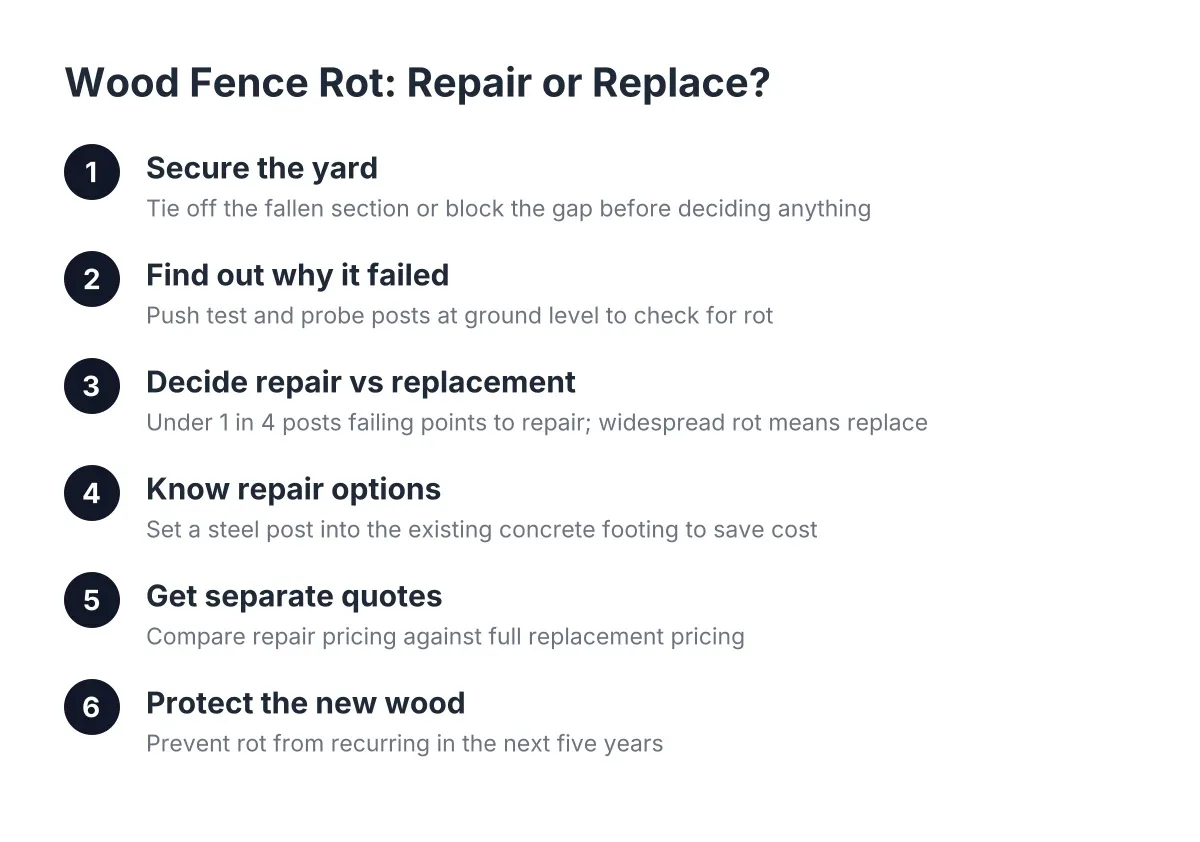
Step 1: Secure the Yard Before You Decide Anything
First, deal with the immediate problem. If a section is down and you have a dog or small kids, the fence decision can wait a day; the open gap cannot.
Lean the fallen section back against the standing posts and tie it off with rope or ratchet straps. If the section is too broken to stand, stretch a temporary barrier across the gap. Plastic snow fencing, a few metal T-posts, and zip ties will hold a dog in for a week or two.
Take photos of everything before you move anything. If a tree or a vehicle caused the damage, your homeowner's insurance may cover part of the work, and the adjuster will want pictures of the fence as it fell, not as you restacked it. Photograph the base of every broken post too; rot at ground level matters for the next step.
Step 2: Find Out Why the Fence Failed
A fence that blew over in a windstorm did not fail because of the wind. Wind is the trigger; rot is usually the cause. A sound wood fence flexes in a storm. A fence with rotted posts folds.
Walk the whole fence line, not just the damaged stretch, and check each post:
- Push test. Grab each post at chest height and push hard. More than an inch or two of movement at the base means the post or its footing is failing.
- Probe at ground level. Take a screwdriver and press it into the post right where it meets the soil. Solid wood resists; rotted wood takes the tip with little pressure. Rot almost always starts in the few inches at and just below grade, where moisture sits against the wood.
- Check the bottoms of pickets and rails. Pickets that wick water from pooling or soil contact rot from the bottom up. Soft, dark, crumbling picket bottoms across a whole run point to a drainage problem, not a one-time event.
- Look at the footings. Concrete that has heaved, cracked, or tilted tells you frost movement is part of the story. Springfield-area soil freezes and moves every winter, and shallow footings work their way loose over the years.
Count what you find. The ratio of failed posts to sound posts drives everything that follows.
Step 3: Decide Between Repair and Full Wood Fence Rot Replacement
Here is the honest decision framework. Rot in one or two posts is a repair. Rot throughout the fence line is a replacement, and money spent patching it is money you will spend again soon.
Repair makes sense when:
- Fewer than about one in four posts fail the push or probe test
- The pickets and rails are mostly sound, with damage limited to the storm-hit section
- The fence is on the younger side and the layout still works for your property
- The footings are intact and the posts rotted above or at the concrete, not the whole assembly shifting
Full replacement makes sense when:
- Rot shows up at ground level across most of the fence line, not just where it fell
- The fence is past its expected life; Angi puts the average wood fence at about 15 years, with some lasting up to 20 depending on wood type and maintenance
- You are repairing it repeatedly; Angi also notes that a wood fence over 10 years old needing frequent repairs is showing replacement signs
- Posts are heaving or tilting from frost movement, which means the footings were set too shallow for New England ground and will keep failing
One pattern worth knowing: panels that look fine can hide failed posts. Homeowners repaint and restain the boards for years while the posts quietly rot at grade, because the posts are the one part you cannot see below the soil line. So a fence that looks well kept can still be a replacement candidate. The posts decide, not the pickets.
Step 4: Know Your Repair Options That Save the Footings
Suppose a homeowner in Springfield has a 100-foot cedar fence, and three posts snapped at the base in a nor'easter while the rest passed the probe test. The instinct is to dig out each old post and its concrete footing, then set a fresh post in new concrete. That is the most expensive and most disruptive path, and it is not always necessary.
An alternative worth asking about: cut the rotted post off above the deteriorated section and set a steel post into the existing concrete footing. The original footing keeps doing its job, the steel post will not rot where the wood post did, and you skip the labor of breaking out and hauling away old concrete.
This approach has another advantage for a fence that is mid-life. The repair keeps the fence standing now, and the footings and steel posts carry forward if you do a full replacement later. You are not throwing the repair money away; you are staging the rebuild.
However, this is not a universal fix. If the footing itself has heaved from frost or the concrete has cracked apart, it needs to come out. A fence contractor who looks at the footing before quoting, rather than defaulting to full excavation on every post, is giving you a straight assessment. That is a fair test when you are comparing wood fence repair options from two or three local companies.
Step 5: Get Quotes That Separate Repair From Replacement Pricing
Next, get your estimates, and structure them so you can compare honestly. When someone searches wood fence repair near me after a storm, the risk is hiring whoever answers first and accepting whatever scope they propose. Instead, ask each fence company for two numbers: the cost to repair the damaged sections, and the cost per foot for a full fence replacement. Seeing both side by side shows you whether a repair-first approach makes sense or whether you are two storms away from paying for both.
A few things to pin down in any fence estimate:
- Post material and setting method. Wood posts are prone to rotting, warping, and twisting over time; steel posts cost more upfront but remove the most common failure point. Ask how deep posts will be set, since frost depth in Western Mass punishes shallow footings.
- Drainage details. Concrete poured tight against a wood post can trap moisture and speed up the rot you are paying to fix. Ask how the installer handles drainage at the post base.
- A rot board. A pressure-treated rot board along the bottom of a cedar fence keeps the pickets out of pooled water and soil contact, which protects the part of the fence that fails first.
- What happens to the old material. Confirm haul-away of broken sections and old concrete is in the price, not a surprise line item.
Be cautious about taking the lowest number on its face. A cheap rebuild with shallow posts and no drainage plan tends to fail early, and rebuilding twice costs more than building it right once. Price the work, but also price the details above.
Step 6: Protect the New Wood So You Are Not Back Here in Five Years
Finally, whether you repaired three posts or replaced the whole run, protect the investment. Rot is a moisture problem, and moisture management is mostly maintenance.
Stain or seal both sides of the fence, not just the side facing your yard. Sealing both faces extends the fence's life well beyond what a one-sided coat does. Keep soil, mulch, and leaf piles off the bottom of the pickets, since ground contact is where rot starts. After heavy snow, knock drifts off the fence line before they sit against the boards through a thaw.
One honest limitation: if your fence sits on a property line with grade changes, or the damage involves a neighbor's tree or an insurance claim, bring in a professional before you commit to a scope. Property line questions and claim documentation are easy to get wrong, and a local installer who works Springfield-area lots regularly will spot issues a quick drive-by quote misses.
Handled in this order, a wood fence rot replacement decision stops being an emergency and becomes a straightforward project: secure the yard, diagnose the posts, match the fix to the actual damage, and build or repair in a way that stands up to the next storm.
If you need fence replacement, Western Mass Fence Co can help.
Prefer to talk it through? Call (413) 305-1309 — a quick call is usually the fastest way to get a straight answer for your situation.