Vinyl Fence Lifespan in Springfield: How Freeze-Thaw Cycles Really Affect It
Ask about vinyl fence lifespan in Springfield and you will get a confident number from almost everyone: 20 years, 30 years, sometimes "a lifetime." The honest answer is messier, and it has less to do with the vinyl itself than with what is happening three feet under it. Western Massachusetts puts fencing through a stress test most national lifespan articles never mention: deep frost, repeated freeze-thaw cycles, wet clay-heavy soils, and winters that heave posts out of plumb a quarter inch at a time. A vinyl fence can absolutely outlast a wood fence here, but vinyl fence freeze-thaw damage can occur in under a decade if the posts were set wrong. This guide explains the actual degradation timeline for vinyl fencing in our climate, what fails first, and what separates a fence that lasts from one that leans.
Why Springfield Winters Are the Real Test
The vinyl panels on your fence are the part you see, but they are rarely the part that fails first in New England. The ground is.
Springfield-area soil freezes deep in a normal winter. When wet soil freezes, it expands. When it thaws, it contracts and settles. That cycle repeats dozens of times between November and April, and every cycle pushes and pulls on anything buried in the ground, including fence posts and the concrete around them.
This is called frost heave, and it does not care what your fence is made of. A post set too shallow, or set in a concrete footing shaped like a mushroom that gives frost something to grab, will get lifted a little each winter. Over five or ten winters, that adds up to a fence that leans, gates that no longer latch, and panels that pop out of their rails. The resulting vinyl fence freeze-thaw damage becomes visible when posts shift out of plumb and panels separate from their moorings.
Here is the part that matters for anyone comparing materials: vinyl handles the above-ground side of a Springfield winter better than wood does. It does not absorb water, so it does not swell, rot, or split when soaked and frozen. The below-ground side, the post setting, is where vinyl fences in this region live or die.
How Vinyl Fence Freeze-Thaw Damage Develops Over Time
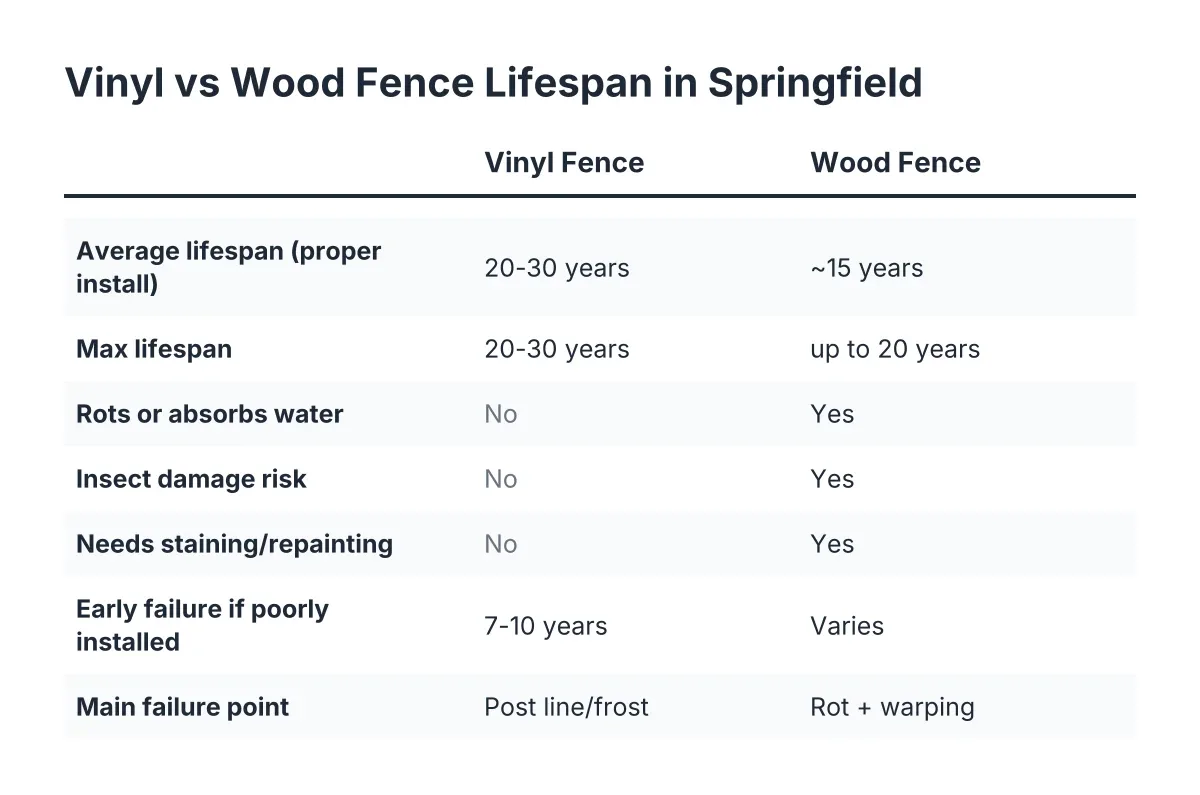
A properly installed vinyl fence in the Springfield area should last 20 to 30 years, and the panels themselves often look presentable the whole time. A poorly installed one can need major post repairs within 7 to 10 years, even though the vinyl itself is fine. The lifespan question here is less about the material degrading and more about the installation surviving frost.
For comparison, wood fences last about 15 years on average, with some lasting up to 20 years depending on wood type and maintenance, according to Angi. Angi also notes that a wood fence over 10 years old needing frequent repairs is usually showing replacement signs. Wood has two failure clocks running at once in our climate: the posts rot at the ground line, and the boards warp, twist, and gray above it. Staining both sides of a wood fence extends its life meaningfully, but that is an ongoing cost and an ongoing chore.
Vinyl removes the rot clock entirely. PVC does not rot, and insects have no interest in it. What remains are three slower degradation paths, which is why the realistic vinyl fence lifespan in Springfield comes down to how well the install handled frost and how good the vinyl was to begin with.
What Actually Degrades on a Vinyl Fence Over Time
Three things age a vinyl fence in this climate, roughly in order of how often they cause problems:
- Post movement from frost heave. The number one cause of early failure. Posts heave, the fence racks out of square, and rails start pulling out of their routed openings. This is an installation problem, not a material problem.
- Cold-weather brittleness and impact damage. Vinyl stiffens in extreme cold. A panel that would flex and shrug off a thrown snowball in July can crack when a snowblower throws ice chunks at it in January, or when a plow pushes a snowbank into it. Damage like this is repairable panel by panel, but it is the most common cosmetic complaint.
- UV exposure. Quality vinyl is formulated with UV inhibitors, so fading happens slowly and evenly over decades. Bargain-grade vinyl fades faster, can chalk, and gets brittle sooner. This is where the price difference between vinyl products actually shows up, usually 10 or 15 years after the install.
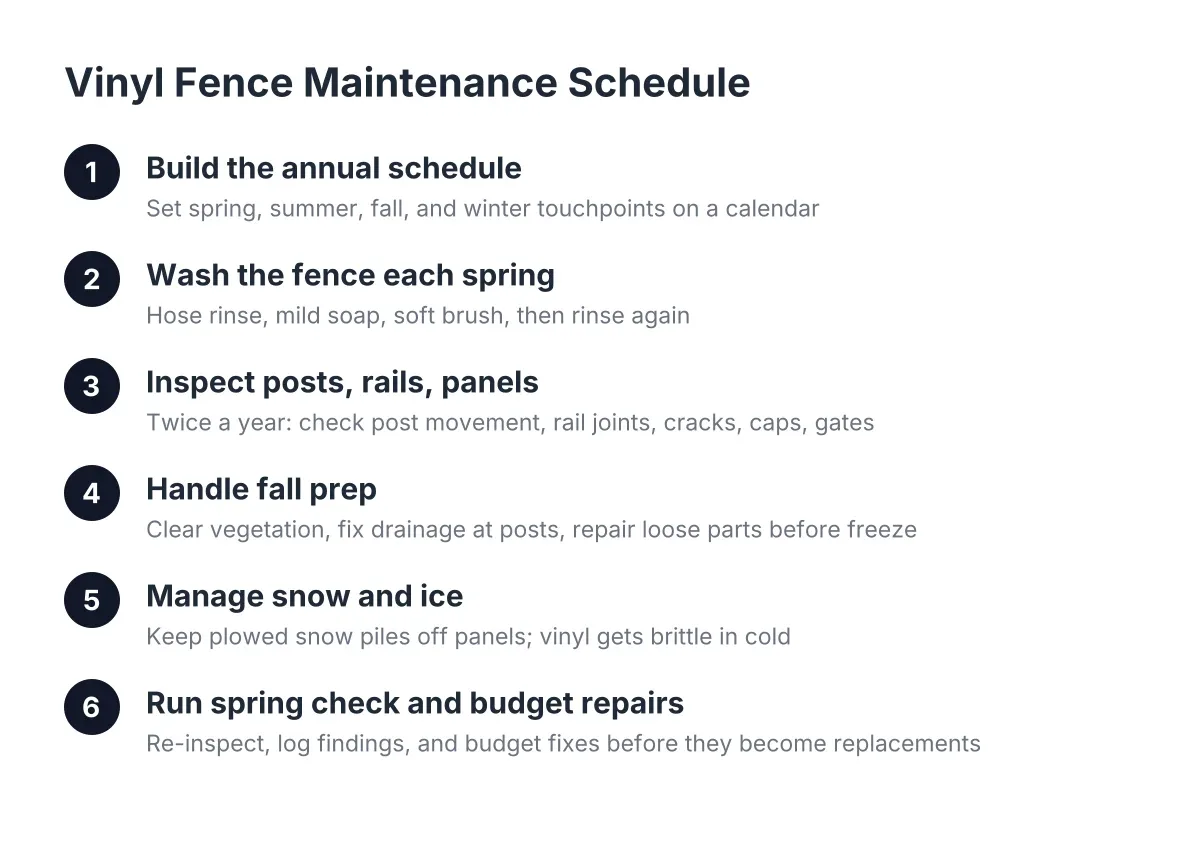
Notice what is not on the list: rot, insect damage, rust, and repainting. Those are wood and chain link fence problems. With vinyl, the maintenance burden is washing it occasionally and replacing the rare cracked picket or rail.
One honest limitation worth stating plainly: vinyl is still PVC. In an extreme fire situation it will burn or melt, and a cracked structural post generally means replacing that post rather than patching it. No fence material is indestructible; vinyl just fails less often and asks less of you in between.
How Freeze-Thaw Cycles Attack the Post Line
Understanding the failure mechanics helps you judge an install before you pay for it, whether you own one new-construction backyard or manage fencing across five commercial sites.
A vinyl fence is a post-and-rail system. The posts are the foundation; they carry all the structural load, and the panels between them are mostly along for the ride. If the posts stay plumb and at the same height for 25 years, the fence looks new for 25 years. If the posts move, everything downstream moves with them.
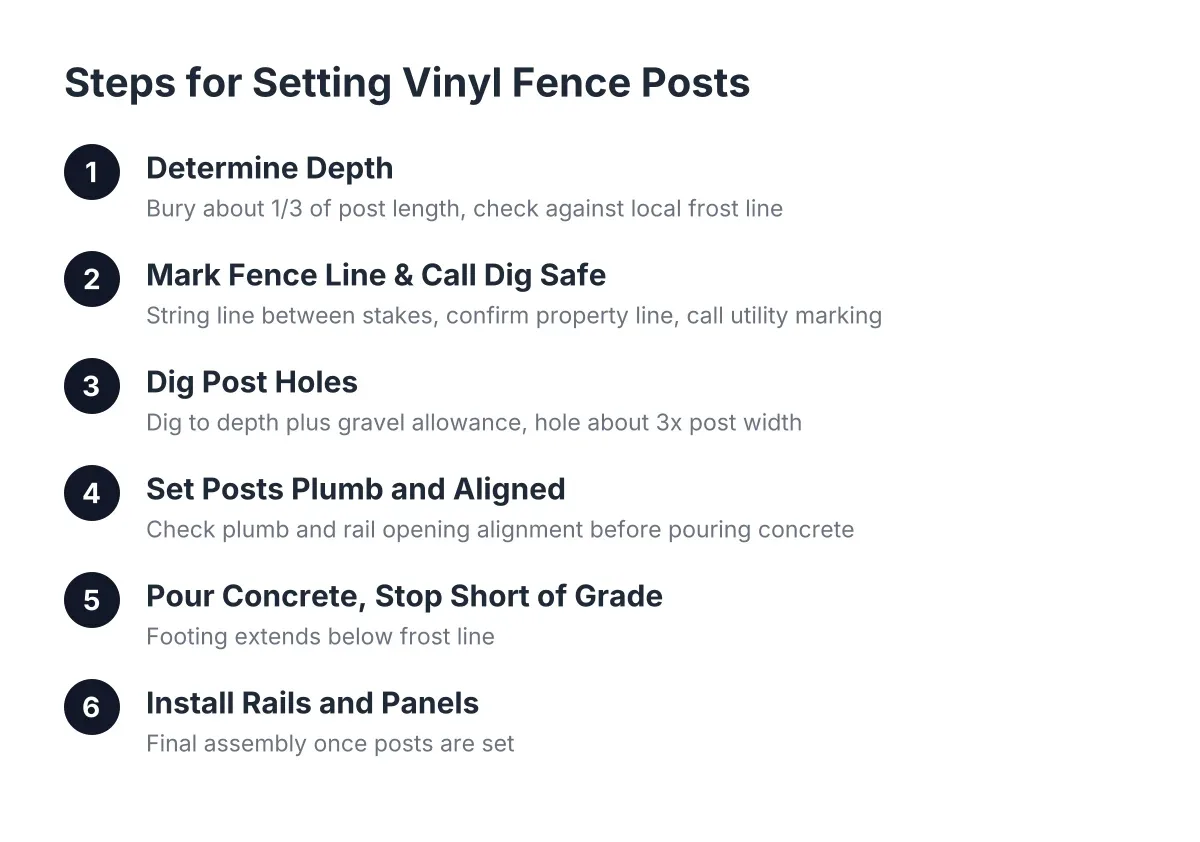
Frost attacks posts two ways. First, it lifts from below: if the bottom of the footing sits above the frost line, freezing soil underneath it jacks the whole footing upward. Second, it grabs from the side: frozen soil adheres to the footing walls and lifts as it expands. A footing poured wider at the top than the bottom gives frost a ledge to push against, which is why experienced installers avoid that shape. These freeze-thaw mechanisms are the primary drivers of vinyl fence freeze-thaw damage in northern climates.
As a result, the difference between a 10-year fence and a 25-year fence in Springfield often comes down to decisions made in a two-hour window on install day: how deep the holes went, how the concrete was shaped, and whether drainage was considered. None of that is visible in photos of the finished fence.
Grade Changes and How Vinyl Fence Freeze-Thaw Damage Worsens on Slopes
Springfield-area lots add their own complications. Older New England neighborhoods have irregular property lines, mature trees with root systems right where a post needs to go, and yards that slope in more than one direction.
Slopes matter for vinyl specifically because panels are assembled from individual pickets set between rails. On a sloped run, gravity wants to slide pickets downhill as they are inserted, so installers often reverse their building direction on grade to keep everything tight. It is a small technique, but it is the kind of detail that separates a crew that installs vinyl weekly from one that mostly does wood.
Obstacles call for workarounds too. When a run has to butt against an existing structure or thread past a tree, a reinforced post, essentially a metal pipe core with the vinyl post sleeved over it, keeps the end of the run rigid where a standard hollow post might flex. These adaptations are routine for a crew that knows the housing stock here, and they are exactly where DIY installs tend to go sideways.
Reading a Vinyl Fence Installation Diagram Like an Installer
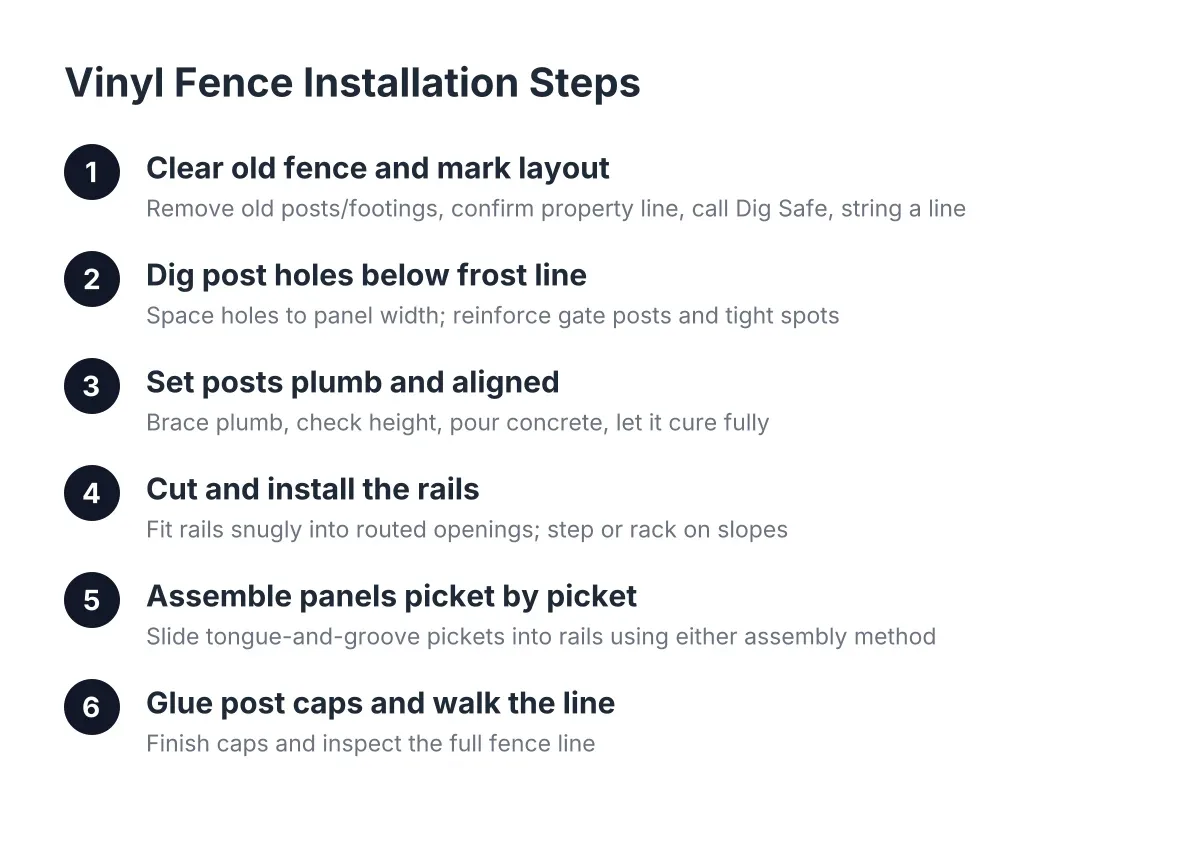
Search for a vinyl fence installation diagram or a vinyl fence installation video and you will find the same basic sequence everywhere: dig holes, set posts in concrete, cut rails to fit between posts, insert pickets, cap it off. The sequence is accurate. What the diagrams skip is everything regional.
Most national diagrams and videos are filmed in places where the ground barely freezes. Their post depths, their footing shapes, and their "posts every 8 feet, done in a weekend" pacing all assume soil that stays put. Watch them to understand the assembly logic; do not treat them as a spec for a Springfield yard.
If you do watch a vinyl fence installation video to prep for conversations with a fence company, here is what to pay attention to and what to ask about locally:
- Post depth relative to frost. The single most important question for this region. Ask any installer how they set posts for frost, and listen for a real answer about depth and footing shape, not a shrug.
- Rail fit. Rails get cut to length so they seat snugly in the routed post openings and lock in with fasteners. Sloppy rail fit shows up later as rattling panels and wind damage.
- Picket retention. Grooved pickets are held by side strips on the posts after the rails are set. Panels can be built pickets-first or top-rail-first; both work, and crews have their preferences. What matters is that nothing relies on friction alone.
- Gate posts. Gates concentrate load. In frost country, gate posts deserve the deepest footings and often reinforcement, because a gate that sags an inch stops latching.
For a new homeowner weighing a weekend DIY against hiring out, the math usually turns on the digging and the frost detail, not the panel assembly. Assembling vinyl panels is genuinely approachable. Setting 15 posts to a consistent depth and height in rocky, rooty New England soil, with footings shaped to shed frost, is the part that justifies professional vinyl fence installation. Get the posts wrong and the tidy panel work on top will not save the fence.
Vinyl Versus Wood and Chain Link Over 20 Springfield Winters
Lifespan comparisons only mean something when they include maintenance and repair costs over the same window. For context, Angi puts the national average fence repair at $618, with most homeowners paying between $304 and $948, and overall fence installation costs averaging $3,277 nationally.
Suppose a couple closes on a new build in a Springfield-area subdivision with a bare quarter-acre backyard and a dog arriving next month. They are choosing between a wood fence, a chain link fence, and a vinyl fence for the perimeter. Here is the honest 20-year picture for that hypothetical yard:
- Wood costs the least per foot up front for a privacy style. However, it needs staining or sealing every few years, posts commonly rot at the ground line even when the boards above are maintained, and by year 15 the replacement conversation has started.
- Chain link is the durability bargain. Galvanized chain link shrugs off frost and weather, which is why it remains the default for commercial fence installation. It just offers no privacy, which rules it out for most backyards with a new dog or a pool.
- Vinyl costs more per foot up front than wood. In exchange, there is no staining, no rot, and no repainting across the whole 20 years. If the posts were set for frost, the biggest likely expense is swapping an occasional cracked picket after a rough winter.
In that scenario, vinyl's higher install cost buys down two decades of maintenance labor and mid-life repair bills. Whether that trade is worth it depends on budget and how long the owners plan to stay. Angi pegs fence installation ROI around 50% of project cost at resale, so a fence is a use-it asset more than an investment, and the longest-serving material tends to win on total cost.
The same logic scales up for a property manager. Say a facilities manager oversees five rental and commercial sites around Springfield, each with aging wood fencing failing at a different rate. Standardizing on vinyl for the tenant-facing runs and chain link for the security perimeters means one maintenance profile instead of five, predictable per-foot numbers for budget approval, and no staining crews to schedule. The vinyl fence lifespan question for Springfield commercial properties is the same one homeowners face, just multiplied: frost-proof posts first, panel quality second.
What to Check Before and After the Install
You cannot inspect a footing after the concrete truck leaves, so the useful checks happen in the fence estimate conversation and in the first two springs.
Before the install, ask the fence company three direct questions. How deep do you set posts for frost in this area? How do you handle slopes and grade changes on this lot? What do you do differently at gate posts and end posts? A local crew that works these soils year-round will answer in specifics. Vague answers are the warning sign.
After the install, the fence will tell you how it was built. Walk the line each spring for the first two years:
- Sight down the top rail. It should be as straight, or as evenly stepped on slopes, as the day it went in. A single high post means frost found a footing.
- Check every gate. Gates reveal post movement before anything else does, because latch alignment has no tolerance for a heaved post.
- Push on mid-run posts. Firm, no wobble. Movement at the base in year one usually means a shallow or undersized footing.
- Look for stress cracks near fasteners and rail openings after extreme cold snaps, especially on runs that catch plow spray or snowblower discharge.
Catch post movement early and a repair is one post. Ignore it for five winters and the racking spreads down the run, which is when a repair job becomes a partial fence replacement.
One more trade-off to weigh honestly: if your lot has severe grade changes, ledge near the surface, or drainage problems that keep soil saturated, get a professional evaluation before committing to any material. Standing water around footings shortens the life of every fence, vinyl included, and some sites need drainage work before fence work.
The Bottom Line on Vinyl Longevity in This Climate
Vinyl fence lifespan in the Springfield area is not really a material question. The vinyl will do its part; quality panels resist rot, insects, and fading for decades with no staining and no repainting. The variable is whether the posts were set by someone who respects what a Western Mass winter does to the ground.
For a new homeowner fencing a bare yard in 2026, that reframes the shopping question. Stop asking which fence material lasts longest in the abstract. Start asking which installer sets posts for frost, handles your lot's slopes and obstacles, and will explain the cost factors behind the fence estimate in plain terms. Get that right and a vinyl fence is the closest thing to a one-time purchase that fencing offers in New England. Get it wrong and even the best panels end up leaning on a bad foundation.
If you need vinyl fence installation, Western Mass Fence Co can help.
Prefer to talk it through? Call (413) 305-1309 — a quick call is usually the fastest way to get a straight answer for your situation.