Wrought Iron Fence Panels: Sizes, Gauges, and How to Measure for Installation
If you are pricing wrought iron fence panels for the first time, the numbers on the spec sheets can feel like a foreign language. Panel widths, heights, rail counts, picket spacing, steel gauge, wall thickness. None of it means much until you know how those numbers play out on your actual property line. This guide walks through how to approach measuring for fence panels, the standard sizes, what gauge actually tells you, and how to measure your yard so the panels you order, or the fence estimate you get, matches the fence that ends up in the ground.
One note before we start. Around Springfield, most "wrought iron" fencing sold today is actually ornamental steel or ornamental aluminum built in the wrought iron style. True hand-forged wrought iron still exists, but it is a custom product. The sizing and measuring principles below apply to all of it, and we will flag where the materials differ.
Why Panel Dimensions Matter More Than Style
Most people shopping for an iron-style fence start with design. Victorian pickets, flat top, spear top, rings, scrolls. That is the fun part, and it matters. But the dimensions decide whether the fence fits your property, meets local rules, and goes in without surprise costs.
Here is the problem. Metal fence panels are rigid. A wood fence can be stick-built on site and adjusted board by board. A vinyl fence panel can be trimmed within limits. An ornamental metal panel comes as a welded or rackable assembly in fixed widths. Your yard, meanwhile, is not built in fixed widths. Property lines in older Springfield neighborhoods run at odd angles, slope downhill, and dogleg around garages and driveways that were poured decades before anyone thought about fence layout.
As a result, the measuring work matters as much as the panels themselves. Get the layout right and the fence reads as one clean line. Get it wrong and you end up with awkward cut sections in the most visible spot in the yard, or worse, a fence that sits on the wrong side of the line.
That last point hits home if you are fencing because of a neighbor dispute. A rigid metal fence set six inches over the line is not a small fix. You are pulling posts set in concrete, not sliding a few boards over. Measure twice is not a cliché here; it is the whole job.
Standard Sizes for Wrought Iron Fence Panels
Ornamental iron and steel fence panels come in a fairly consistent set of sizes across manufacturers, whether you are looking at wrought iron fence panels for sale at a big-box store or ordering through a local fence company.
Panel widths
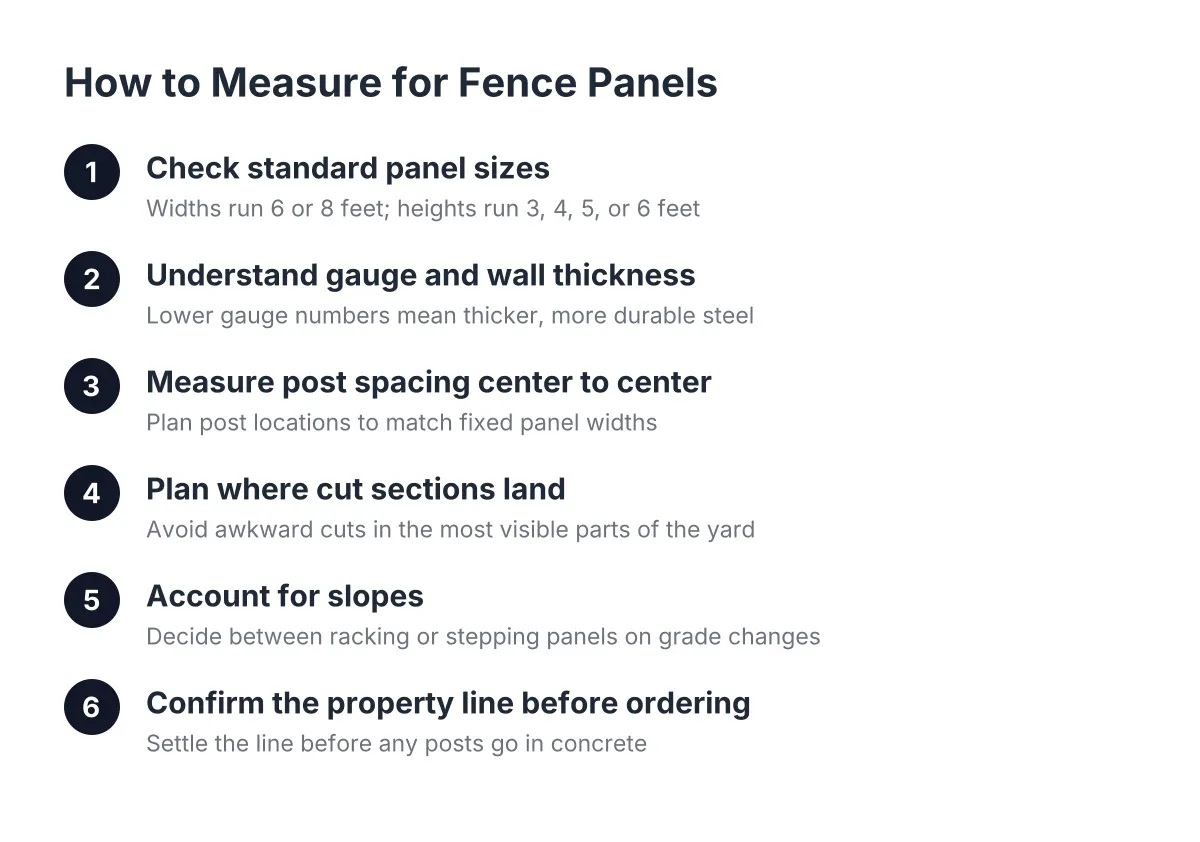
Most panels run 6 feet or 8 feet wide. Six-foot panels are common in residential lines because they are easier to handle, put posts closer together for strength, and leave smaller leftover gaps at the ends of runs. Eight-foot panels cover ground faster and can lower the cost per foot on long, straight runs, which is why they show up often on commercial fence projects and larger rental properties.
Panel heights
Residential heights typically run 3, 4, 5, and 6 feet.
- 3 feet: garden borders, front-yard accents, and decorative edging. The short staked panels sold at home centers live here.
- 4 feet: the workhorse height for front yards and many pool enclosures, though pool fencing has its own code requirements you should confirm with your local building department.
- 5 feet: a common pick for pet containment and backyard boundaries where you want visibility plus real height.
- 6 feet: security and commercial applications, or a boundary fence where you want an unmistakable line.
One local note on height. Under the Massachusetts State Building Code, a fence over 7 feet requires a building permit, while fences 7 feet or less generally do not, according to the Town of Duxbury, MA. Almost every residential ornamental fence falls under that threshold, but your city or town may have its own zoning rules on fence height and placement, especially along front property lines. Check with your municipality before you order anything.
Rails and picket spacing
Panels come with two or three horizontal rails. Three-rail panels are stiffer and carry a more traditional look. Picket spacing usually falls just under 4 inches, which keeps kids and most dogs on the correct side. If the trigger for your fence is a neighbor's dog wandering into your yard, picket spacing is the spec to check first, not the finial style.
What Gauge and Wall Thickness Actually Tell You
Gauge is where metal fencing separates into quality tiers, and it is the number most homeowners skip. Here is the plain version.
For tubular steel and aluminum fencing, pickets and rails are hollow tubes. The gauge, or wall thickness, tells you how much metal is in the tube wall. Thicker walls mean a heavier, stiffer, more dent-resistant fence. With steel gauge numbers, lower is thicker: a 16-gauge picket has more steel in it than an 18-gauge picket. Aluminum is usually specced by wall thickness in inches instead of gauge.
Why does this matter to you? Three reasons.
- Durability against impact. A thin-wall picket bends when a kid climbs it, a branch falls on it, or a snowblower throws ice chunks at it all winter. Thicker-wall panels shrug that off.
- Longevity of the coating. Better panels pair thicker steel with galvanizing under the powder coat. Rust starts at scratches and welds; more protective layers mean more years before you see orange.
- Honest price comparison. Two sets of wrought iron fence panels can look identical in a photo and differ widely in wall thickness, coating, and expected lifespan. Fence pricing reflects construction, materials, and longevity, not just the shape of the pickets. When one quote comes in far below another, gauge and coating are usually where the difference hides.
This is also where the iron-versus-aluminum question comes in. Ornamental aluminum fence panels will not rust, which matters in a Springfield winter where road salt and snow piles sit against the fence line for months. Steel in the wrought iron style is stronger per picket but depends on its coating to survive. There is no universally right answer; it depends on whether impact strength or zero-rust maintenance matters more for your property. We cover that tradeoff in depth elsewhere, but for sizing and measuring purposes, both materials follow the same rules.
How to Measure Your Yard for Iron Fence Panels
You do not need surveying equipment to rough out your project. You need a long tape measure, some stakes or marking paint, and an hour. Here is the process a careful installer follows, simplified for a homeowner doing a first pass.
- Confirm the line before anything else. If you have a plot plan or an old survey, pull it out. If the fence is going up because of a boundary disagreement, do not measure from where you think the line is. More on this below, because it is the step that sinks more fence projects than any measurement error.
- Mark your corners and ends. Place a stake at every point where the fence starts, stops, or changes direction. Each of those points gets a post.
- Measure each straight run separately. Do not measure one big loop. A fence with four runs is four separate measurements, because panels cannot bend around a corner.
- Mark gate locations and subtract them. Decide where you need a walk gate, and whether you need a double gate for mower or vehicle access. A wrought iron fence gate is sized separately from the panels, so pull its width out of the run before you count panels.
- Divide each run by panel width. A 50-foot run with 6-foot panels gives you eight full panels and a 2-foot remainder. That remainder becomes a cut section.
- Note the grade. Walk each run and flag anywhere the ground rises or falls noticeably. Slope changes how panels are hung, which we will get to.
Post spacing and measuring for fence panels: center to center
Here is the detail that trips up most DIY measurements. Post spacing is measured from the center of one post to the center of the next, not from edge to edge. A "6-foot panel" system is designed around posts set on specific centers, and the panel itself is slightly shorter than 6 feet to fit between them. Measure edge to edge and every panel in the run drifts, until the last one does not fit at all.
Plan where the cut sections land
Almost no run divides evenly into full panels. Somewhere, a panel gets cut down to fill the remainder. Good installers do not leave that to chance. They place cut sections in the least visible spots, behind the garage or at the far back corner, and keep full panels along the street and the main sightlines from the house. At a corner where a cut lands, adding a picket at the corner post hides the cut edge. If you are getting quotes, ask how the installer plans to handle the odd section. The answer tells you how much they think about the finished look.
Slopes: racking versus stepping
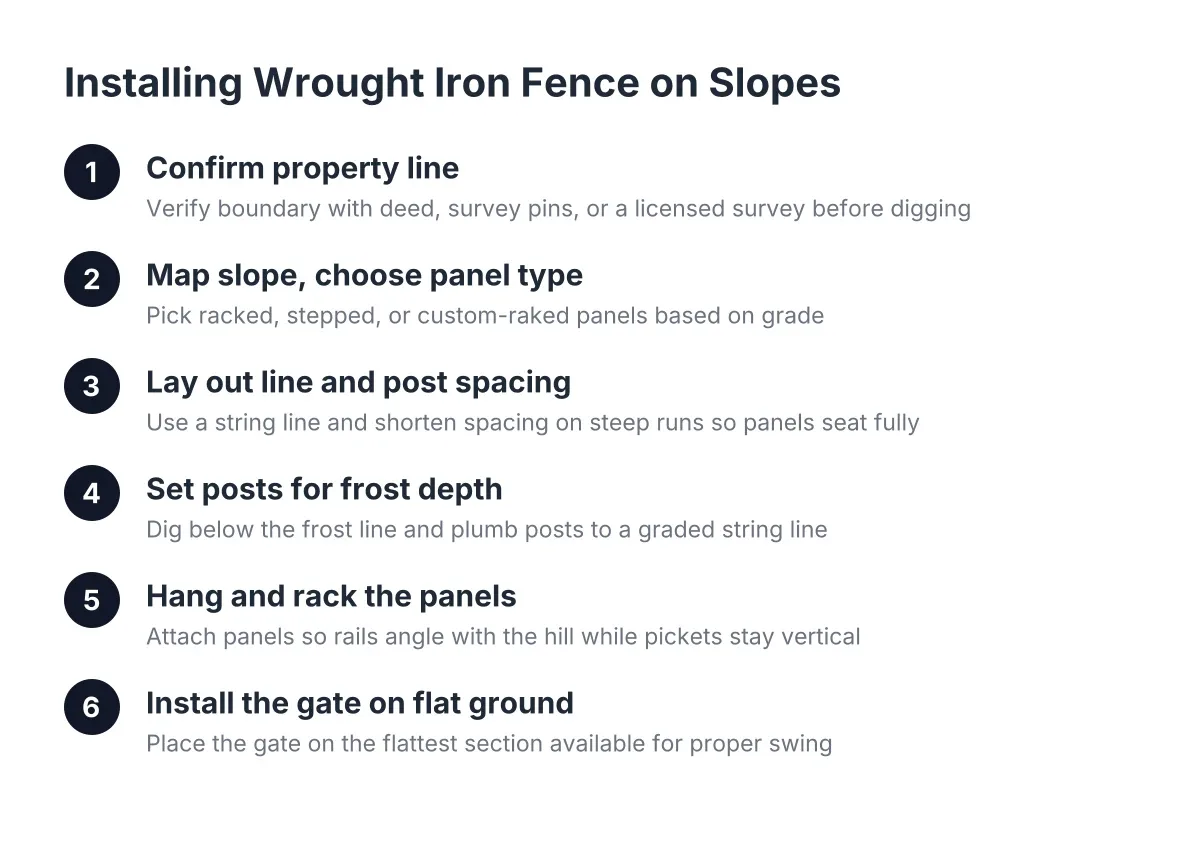
Springfield-area lots are not flat, and older New England neighborhoods have grade changes that complicate layout. Metal panels handle slope two ways. Rackable panels pivot at the rail connections so the panel follows the grade and the bottom gap stays even. Welded panels cannot rack, so they get stepped down the hill like stairs, which leaves triangular gaps under each panel. If the fence exists to keep a dog in or out, those step gaps are exactly where a determined dog goes through. On a sloped line, rackable panels are usually worth specifying. When measuring panels on a slope, account for how the racking or stepping will affect the actual coverage along your property line.
Why the Property Line Question Comes Before the Tape Measure
Suppose a homeowner in a Springfield neighborhood wants a 5-foot ornamental fence along one side yard because the neighbor's dog keeps crossing over, and the two households no longer agree on where the line sits. The old chain link fence that used to mark it came down years ago. In that scenario, every measurement in the previous section is premature, because the starting point itself is in dispute.
A fence company installs where you direct them; it cannot legally establish your boundary. A licensed land surveyor does that. If there is any real disagreement with a neighbor, the survey is cheap insurance compared to the alternative. A rigid metal fence with posts in concrete is the worst type of fence to relocate. Pulling and resetting a run of panels and posts costs real money and restarts the exact conflict you built the fence to end.
Therefore, think of it in three tiers. If your plot plan is clear and the neighbor agrees, you can proceed with confidence. If markers are missing but there is no conflict, a surveyor can set pins without a full boundary survey in many cases. Additionally, if there is an active dispute, get the survey, keep the documentation, and have the installer set posts a few inches inside your line so there is no argument later. For legal questions beyond placement, who pays for a shared fence or an easement issue, talk to a lawyer, not a fence contractor.
Landlords face a version of the same problem multiplied across properties. If you own several multi-family buildings around Springfield, one disputed line at one property can stall a fence replacement you planned to roll across three. Settle the line questions first, then schedule the installations together; a contractor measuring and mobilizing for multiple properties at once can often sharpen the per-property fence estimate.
What Installation Includes and What Panels Cost
A full ornamental fence installation from a fence company typically covers layout and marking, utility locating through Dig Safe before any digging, post holes dug below frost depth, posts set in concrete, panels hung and leveled, and gates fitted and adjusted. Haul-away of an old fence is sometimes included and sometimes a line item, so ask.
Frost depth is the local detail that matters most. Western Massachusetts winters push frost deep into the ground, and posts set too shallow heave upward over a few freeze-thaw seasons. On a rigid metal fence, one heaved post throws off the alignment of every panel attached to it. Deep-set posts in proper footings are not an upsell; they are what keeps the fence straight in year ten. A careful crew also checks that each new panel's picket tops run level with the neighboring section before fastening, which is the difference between a fence that reads as one line and one that waves down the street.
On cost, be careful with national figures, because they blend every material. According to Angi, fence installation overall averages $3,277 nationally, with most homeowners paying between $1,860 and $4,843. Ornamental metal generally lands above the midpoint of fencing materials per foot, while chain link sits at the economical end and wood in between. Your actual number depends on height, gauge, total footage, gates, slope, access, and how many cut sections the layout requires. Any fixed price quoted before someone walks your line is a guess.
Worth knowing as well: Angi puts the average return on investment for a fence at about 50 percent of project cost. A fence is partly a property improvement and partly a problem solver. For the homeowner with a boundary conflict or the landlord with a code notice, the problem-solving half usually justifies the project on its own.
DIY Panels or a Professional Installation
The 3-foot staked wrought iron fence panels sold at home centers are a legitimate DIY product for garden borders. They press into the ground, mark an edge, and come out just as easily. If that is all you need, buy them and enjoy your Saturday.
A real boundary fence is a different job. Post holes below frost line, concrete, dead-level runs across uneven grade, and gates that still latch after a winter of ground movement take tools and experience most homeowners do not have on hand. Add a sensitive property line to the mix and the case for a professional gets stronger, because a documented, correctly placed installation is most of what you are paying for.
When you talk to installers, three questions sort them fast:
- How will you confirm placement relative to my property line, and will you document it? The right answer involves your survey or plot plan, not "wherever you want it."
- What gauge or wall thickness is in this quote, and what coating is on it? If they cannot answer, they are reselling whatever panels were cheapest that week.
- How will you handle the slope and the cut sections? You want to hear racking, stepping, and a plan for where the short sections land.
A fair quote itemizes footage, panel height and spec, post count, gates, concrete, and old fence removal. A single lump number with no breakdown makes comparison impossible and change orders likely.
If you are in the Springfield area and weighing an ornamental metal fence, whether for a disputed side yard or across a portfolio of rentals, Western Mass Fence Co installs ornamental aluminum fencing in the wrought iron style and will walk your line, talk through panel sizes and placement, and give you a straight fence estimate with the specs spelled out. Reach out when you are ready to put a tape measure on it.
If you need fence installation, Western Mass Fence Co can help.
Prefer to talk it through? Call (413) 305-1309 — a quick call is usually the fastest way to get a straight answer for your situation.