Fence Repair Terms Explained: A Plain-English Glossary
If you're getting quotes to fix a leaning or damaged fence and keep running into words you half-recognize, this fence repair glossary is for you. It covers the terms Springfield-area homeowners hear most when a contractor walks the fence line, so you can read an estimate line by line instead of nodding along. Each entry starts with a plain definition, then tells you why the term matters for your project and your fence cost. No sales pitch, just the vocabulary of the trade in plain English.
- Fence Post: the vertical backbone of the fence
- Post Footing: the concrete anchor around a post
- Frost Heave: winter ground movement that tilts posts
- Frost Line: how deep the ground freezes
- Rail (Stringer): the horizontal board pickets attach to
- Picket: the vertical face board on a wood fence
- Fence Panel: a pre-built section of fencing
- Gate Sag: a gate dropping out of square
- Tension Bar and Tension Band: hardware that keeps chain link tight
- Top Rail: the pipe along the top of a chain link fence
- Dry Rot: wood decay from fungus
- Post Rot: decay at the base of a post
- Grade: the slope of the ground along the fence line
- Racking vs. Stepping: two ways to run a fence downhill
- Property Line Survey: the legal map of where your land ends
- Cost Per Foot: how fence pricing is usually quoted
- Scope of Work: the written list of what a job includes
- Repair vs. Replacement Threshold: when fixing stops making sense
Posts, Footings, and the Ground They Sit In: Essential Fence Repair Glossary Terms
Most fence problems in New England start underground, so this part of the fence repair glossary covers the terms that explain why your fence leans in the first place.
Fence Post
A fence post is the vertical support that holds the entire fence upright, set into the ground at regular intervals. Everything else, rails, pickets, or chain link fabric, hangs on the posts. When a contractor says a post is "shot," they mean the fence can't be fixed without digging that post out and setting a new one. Post work is more labor than board work, so a quote with post replacement will cost more than one that only swaps surface pieces.
Post Footing
A post footing is the concrete base poured around a post below ground to anchor it in place. A cracked or shallow footing lets the post wobble even if the post itself is sound. If an estimator mentions "re-setting the footing," expect digging, old concrete removal, and new concrete, which adds labor to the job. In older Springfield-area yards, footings were sometimes set too shallow for our winters, which leads straight to the next term.
Frost Heave
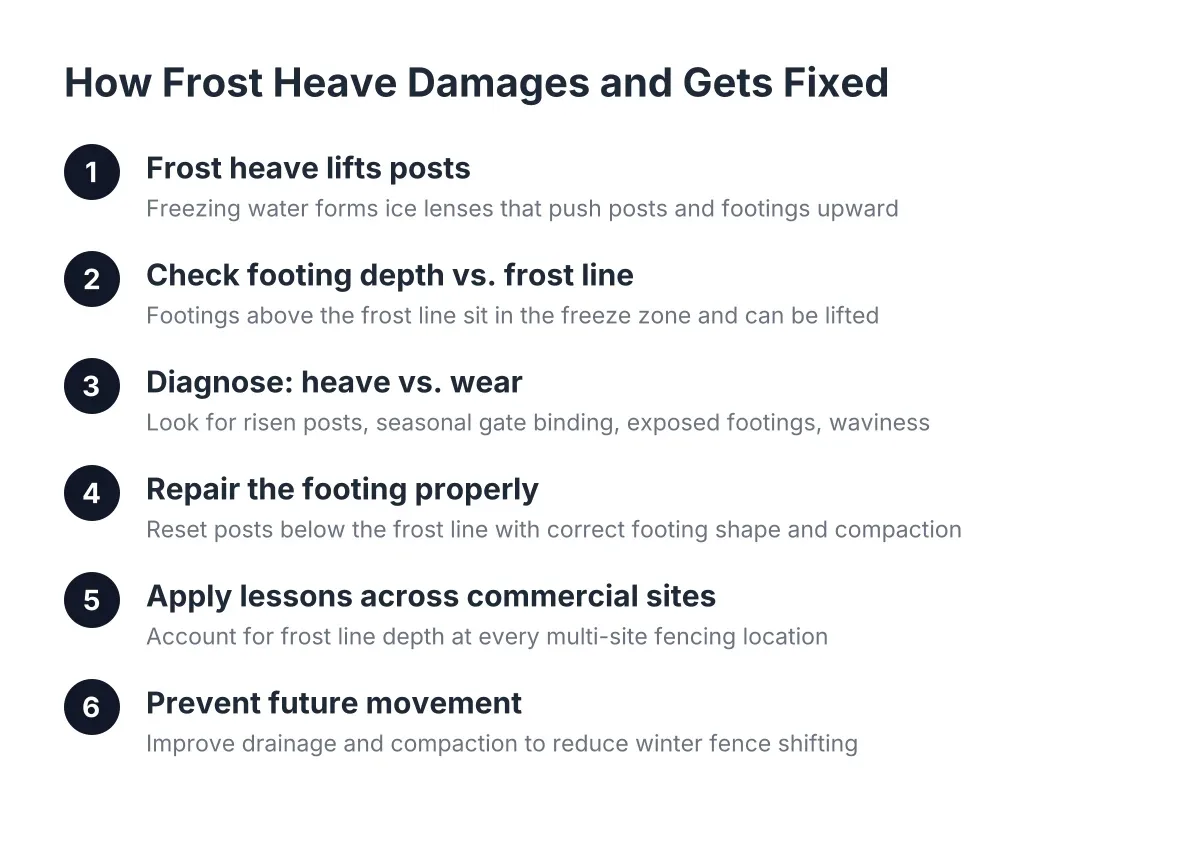
Frost heave is the upward push of soil when the water in it freezes and expands, lifting anything set in the ground, including fence posts. It's the reason a fence that looked straight in October can lean by April. A post that heaves once will usually heave again unless it's re-set below the frost line. If a contractor blames frost heave, ask whether the fix includes deeper footings or just straightening what's there.
Frost Line
The frost line is the maximum depth the ground freezes in winter in a given region. Posts set below the frost line stay put because the freezing soil above them can't get a grip and lift them. In western Massachusetts the frost line runs deep, so proper post depth matters more here than in milder climates. A quote that mentions setting posts "below frost" is a sign the installer understands local conditions.
Parts of the Fence Itself: Terminology for Repair Glossary Decisions
Rail (Stringer)
A rail, also called a stringer, is the horizontal board that runs between posts and carries the pickets on a wood fence. Most wood fences have two or three rails per section. A sagging or cracked rail makes a whole section droop even when the posts are fine. Rail replacement is a mid-size repair: more involved than swapping pickets, less involved than re-setting posts.
Picket
A picket is the individual vertical board on the face of a wood fence. Pickets take the most weather and are the cheapest part to replace, which is why a few broken pickets alone rarely justify a full fence replacement. If most of your pickets are splitting or the fasteners no longer hold, though, the wood may be at the end of its life. Our guide on signs your fence needs repair vs. full replacement walks through how to tell the difference.
Fence Panel
A fence panel is a pre-assembled section of fencing, typically the span between two posts, built as one piece. Vinyl fence and some wood fence styles are sold as panels rather than individual boards. Panel construction matters for repairs: if one part of a vinyl panel breaks, you may need to replace the whole panel because the pieces aren't sold separately. Ask whether your fence style allows piece-by-piece repair or panel-by-panel replacement.
Gate Sag
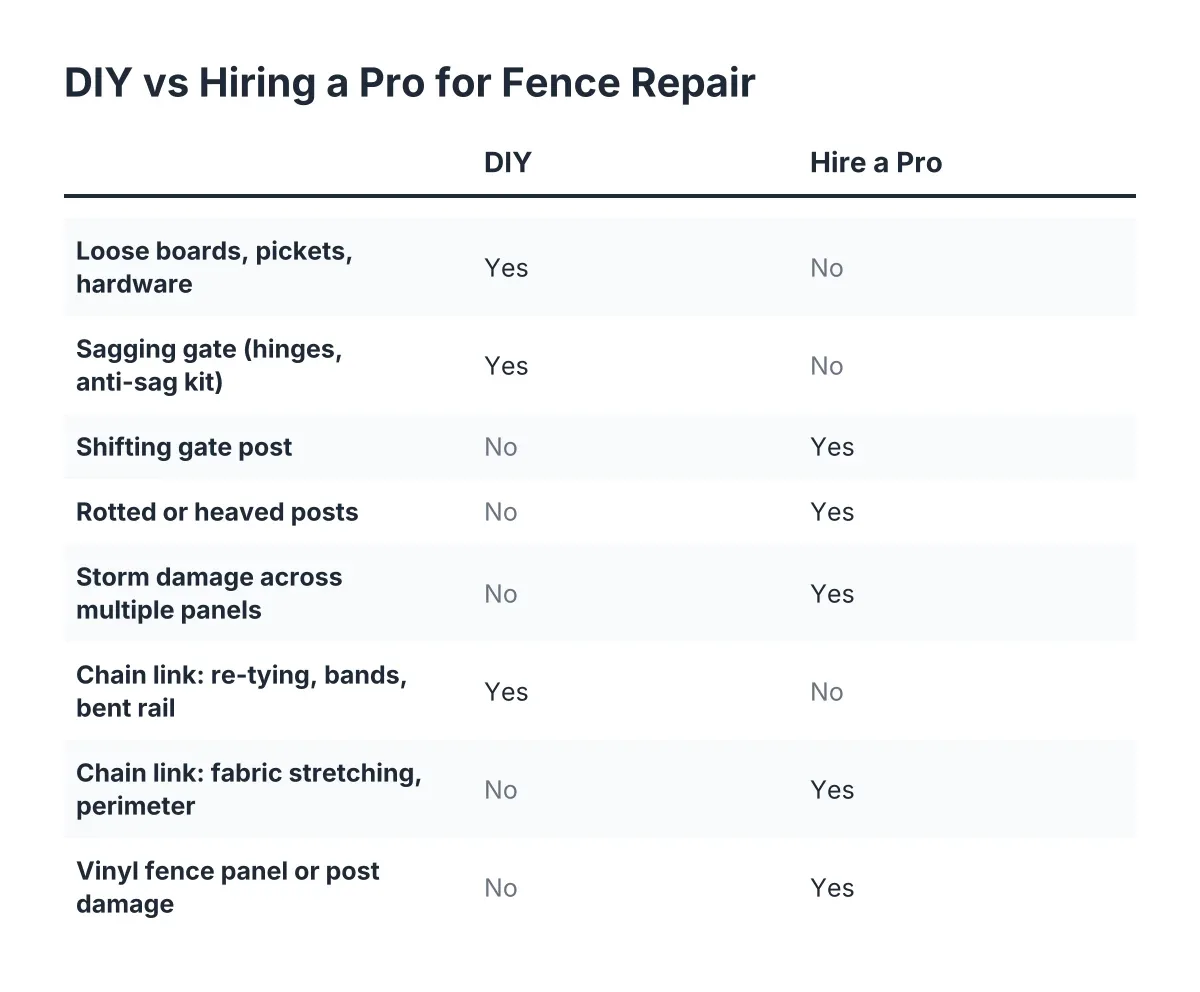
Gate sag is the gradual dropping of a gate out of square, so it drags on the ground or won't latch. It usually comes from a leaning hinge post, loose hinges, or a gate frame that has worked itself out of shape. Sag is one of the most common fence repair calls, and the fix ranges from tightening hardware to replacing the hinge post entirely. The cause determines the cost, so a good estimator will tell you which one you have.
Tension Bar and Tension Band
A tension bar is a flat metal bar woven vertically through the end of chain link fabric, and tension bands are the clamps that bolt that bar to the post. Together they keep a chain link fence stretched tight. When chain link sags or pulls away from an end post, failed tension hardware is often the culprit. It's a smaller repair than replacing fabric, so it's worth asking whether re-tensioning alone will solve the problem.
Top Rail
A top rail is the horizontal pipe that runs along the top of a chain link fence and keeps the fabric from folding over. A bent top rail, often from a fallen branch or a climbing kid, is a common chain link repair. Sections of top rail can be cut out and replaced without touching the rest of the fence. If the bend also kinked the fabric below it, the repair scope grows.
Damage, Slope, and Property Lines
Dry Rot
Dry rot is wood decay caused by fungus that breaks down the fibers, leaving boards soft, crumbly, or hollow-sounding. Despite the name, it needs moisture to start. Rot spreads, so a contractor who finds it will usually probe nearby boards to map how far it goes. Scattered rot means spot repairs; widespread rot pushes the conversation toward fence replacement.
Post Rot
Post rot is decay concentrated at the base of a wood post, right at or just below ground level where moisture collects. It's the most common reason a wood fence leans, because the post fails where you can't see it. A simple test: push the post hard, and if it moves at the ground line, suspect rot below grade. Post rot can't be patched; the post has to come out.
Grade
Grade is the slope of the ground along your fence line. Flat yards are rare around Springfield's older housing stock, and grade changes affect how a fence is built, repaired, and priced. A repair on a sloped section takes more fitting and cutting than the same repair on flat ground. If your estimate mentions grade, that's the installer accounting for real conditions, not padding the bill.
Racking vs. Stepping
Racking and stepping are the two methods for running a fence down a slope: a racked fence tilts each section to follow the ground, while a stepped fence keeps sections level and drops them like stairs. The method matters for repairs because replacement panels and rails have to match the existing approach. Stepped fences leave triangular gaps under some sections, which matters if you're fencing for a dog. Ask which method your fence uses before approving section replacements.
Property Line Survey
A property line survey is a professional measurement that establishes the exact legal boundaries of your lot. Fences are supposed to sit on or inside your line, and older New England lots often have boundaries that don't match where the old fence stands. If a repair involves moving or re-setting posts near a disputed edge, a survey protects you from building on a neighbor's land. It's a separate cost from the fence work itself, done by a land surveyor, not the fence company.
Pricing and Paperwork
Cost Per Foot
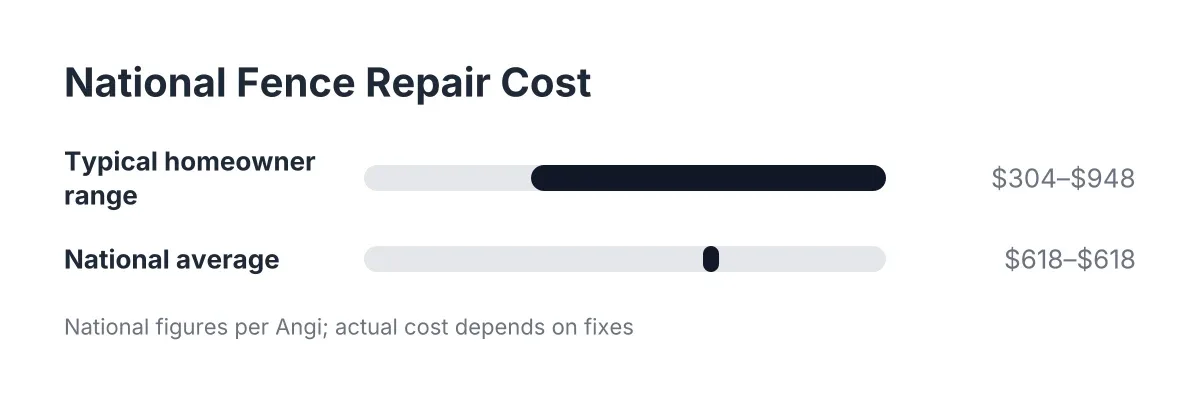
Cost per foot is the standard way fence work is priced: the total divided by the length of fence involved. It lets you compare quotes, but only if both quotes cover the same scope. A lower cost per foot that skips post replacement isn't cheaper; it's a smaller job. For a breakdown of what drives the numbers, see how much fence repair costs.
Scope of Work
A scope of work is the written description of exactly what a job includes: which sections, which parts, what materials, and what cleanup. It's the single most useful document for comparing fence estimates. If one quote says "repair fence" and another lists posts, rails, and haul-away, the detailed one tells you what you're actually buying. Ask any contractor who gives a one-line estimate to spell out the scope before you sign.
Repair vs. Replacement Threshold
The repair vs. replacement threshold is the point where fixing a fence costs enough, relative to its remaining life, that replacing it makes more sense. There's no universal number; it depends on the fence material, its age, and how much of it is failing. As a rule of thumb, isolated damage favors repair, while widespread rot, rust, or leaning favors fence replacement. A straight-shooting local fence company will tell you when you've crossed that line, and our fence repair service page explains how we make that call.
Using These Terms
This fence repair glossary gives you the ability to read an estimate the way an installer writes one: posts and footings first, then rails and panels, then the ground and the property line. You can now ask whether a leaning post is heaved or rotted, whether a sagging gate needs hardware or a new hinge post, and whether a cost per foot covers the same scope in each quote. That's enough to have a real conversation with any fence company, including us.
If you need fence repair, Western Mass Fence Co can help.
Prefer to talk it through? Call (413) 305-1309 — a quick call is usually the fastest way to get a straight answer for your situation.